I Am Frankelda comes from that tradition of allegedly “family-friendly” animated movies from around two or three decades ago, when the boundless vision of some slightly twisted filmmaker resulted in the type of movie that could give a youngster a solid series of nightmares for a good few days or even a week. The premise is almost deceptively ingenious: A young woman, after having some trouble making a name for herself as an author of science fiction and fantasy, goes one step further in her ambitions. She’s going to author others’ nightmares, quite literally, on account of suddenly gaining entry into a lateral dream world.
It isn’t just any realm that she enters, though, to be sure. No, Francisca Imelda (voice of Mireya Mendoza), the young writer living in Mexico sometime in the 19th century, is able to enter a realm that looks a lot like—but, crucially, is not—her own subconscious, to find that the source of her imagination has somehow come to reflect the realities and the happenings within that other realm. We’ve encountered a couple variations on a plot like this before, but we have almost certainly never seen it accomplished the way fraternal directors Arturo and Roy Ambriz have visualized it.
The brothers, who also wrote the screenplay, have devised a prequel picture to their own limited TV miniseries “Frankelda’s Book of Spooks,” which played over the course of five episodes in 2021. Knowledge of the series, thankfully, is not required to understand this movie (this critic was unaware of it until the literal moment of tuning in), which tells a fully standalone story. We do, though, come away with the idea that there could be more to these characters, as well as the hint of a sequel idea by the end—though not, as seems to be the way of things these days, any sort of obvious promise or “stinger” for such a sequel.
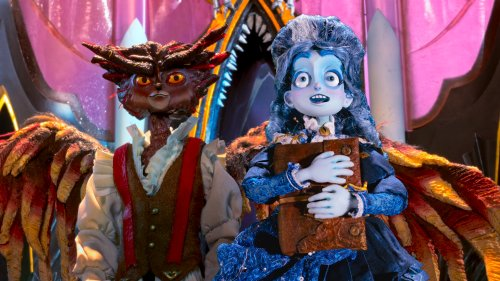
The most important thing here is to note that the Ambrizes have chosen the path of stop-motion animation, unaided by any computer or digital effects apart from some supernatural business that occasionally requires something cartoonish in the frame. In this age of artificial embellishment, this is obviously refreshing, but it’s also a good reminder of why we don’t need such embellishment. Every inch of this production, though it does have a slight feel of having been done with a smaller budget than the usual animated fare, is an overwhelming Gothic delight, from the sets to the costumes to the character designs.
That last one is where the inspiration is the most obvious, because upon the moment of Francisca’s transformation into “Frankelda” (the name is a portmanteau of her two real ones, chosen by way of trying to destroy it on paper with ink and quill), her hair is slicked back into a frizz with some height and even a hint of white, reminiscent of the woman betrothed to the monster of Frankensteinian birth. She also floats, unsupported by anything but her own ghostly trail of spirit dust.
The faces have a carved quality, wooden in nature but still fully alive for the purpose of engaging in songs, and there are quite a lot of those (complementing a stunning music score, by Kevin Smithers), reminiscent of Andrew Lloyd Webber in the way they could belong to the opera. The sets and backdrops are the stuff of early Henry Selick or Tim Burton, imbued with a fragile melancholy reflected in the story’s own sense of tragedy and tragic irony. In a way, it almost makes the story itself rather irrelevant, if only because it’s so simple by comparison.
It begins in childhood for Francisca, who loses a mother to a mysterious blood disease and is housed with her stern grandmother, with her penchant for discouraging her granddaughter from pursuing anything with imagination. Two decades later, Francisca is looking to publish her stories in a world that would look down upon her for her womanhood. That’s when the characters of her imagination—Herneval (voice of Arturo Mercado Jr.), prince of the Topus Terranus, and Procustes (voice of Luis Leonardo Suárez), its Royal Nightmare Maker—bleed into her own reality, summoning her to take charge of the dreamscape that she either created herself or, perhaps, accidentally realized in her own way.
It doesn’t matter too much that the film occasionally strains to make something out of this plot to fit the length of the feature, as Procustes obviously becomes the villain of the piece while Herneval plots to overthrow him by installing Francisca as the new author of nightmares. What matters the most about I Am Frankelda is that it’s a genuinely visionary animated effort in the ways that really count.
Rating: *** (out of ****)


Leave a Reply