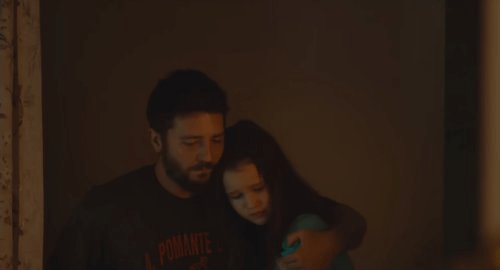
Omaha is such a deliberately small film, featuring a spare cast of three characters whom we follow without any distractions, that one could be forgiven for finding it relatively ineffectual. Screenwriter Robert Machoian tells a simple story, with an arguably even simpler goal, ending with a coda that provides a bit of context about its story (which is fictional but, given that context, probably quite close to someone’s actual experience somewhere in the United States). It would be too much of a spoiler for the sole mission of the film to reveal that context, but let’s only say the film takes place in 2008, when a certain piece of legislation had recently passed in Nebraska.
Director Cole Webley’s feature debut, though, is an intentional act of understatement until the moment something connects within this story, which is specifically in the final ten minutes. It’s a road-trip movie of particular solemnity for so long that we start to question whether Webley or Machoian even have a point, other than to observe the film’s protagonist, a nameless father played by John Magaro, and his two children, Ella (Molly Belle Wright) and Charlie (Wyatt Solis), as they uproot themselves and travel clear across the United States. There is a point, though, and it involves quite a gut punch, as well as a little trust in the filmmakers.
It does help that the film contains a trio of worthy performances at its center: Magaro conveys a heap of internalized anxiety, a constitution of certainty and a deep, abiding love for his children, in spite of everything this father has been through to give them a good life. Wright and Solis are both fully naturalistic, only slightly precocious because these kids are in their way, rather than aggravating in their own precociousness at trying to “play” a couple of kids. There is a fully functional feeling of a family unit here, and that also extends to the obvious, gaping hole in that unit.
The kids’ mother—the man’s wife—has died after a short but devastating illness, and because it’s 2008 (when something apart from that unspecified piece of state legislation was going on, too, for nearly everyone in the country), the loss of half their income has led to the bank’s seizure of their home. When Dad wakes his kids and announces that they’re going on a “little trip,” our ears perk up immediately. Charlie is, perhaps, too young to see the signs at first, but Ella is 10 and gaining in situational awareness—which will be crucial going forward, by the way, because she is the avatar for the audience, not her father.
Ella quickly realizes that this family’s road trip might be one-way, directionally speaking, but of course, she has no concept of the surrounding events, except that she misses her mom and really wants her dad to explain more fully. Dad, though, is dead-set upon his goal of driving to Omaha for no reason that he will even provide hints about. That involves keeping his children together, of course, but it also involves a few hard decisions along the way.
The family has a dog, for instance, to begin with, but without revealing too much, it becomes a slight burden upon the purpose of the trip, which requires Dad to strip everything down to the barest of essentials. Money is so tight that every dollar spent etches a new line in this father’s face (a moment involving a card balance arrives so early in the trip that it’s both jarring and devastating), until it’s clear that his strain comes from a different source entirely. Again, Magaro is quite good here in a series of close-ups that reveal a world of misery underneath.
It all builds to a finale which features a decisiveness of purpose in battle with all of the anxieties—both economic and existential—bubbling underneath the father’s stoic exterior, heavy with concentration (a character played by Talia Balsam shows up in those final moments to offer a bit of comfort and a lot of pragmatism). Omaha is a small film, indeed, and occasionally to a fault, but it does come together in a way that speaks volumes about what has gone unspoken by its characters.
Rating: *** (out of ****)


Leave a Reply