One of the great pleasures of a documentary by the eminent Werner Herzog is being introduced to some subject or idea that we never quite expected, and that expectation is certainly fulfilled by Ghost Elephants. On the surface, this is simply another nature documentary about the search for an animal on the African plains. Below that surface is a genuine anthropological study of a people who might, a secondary subject strongly suggests, be the very first people to walk the earth.
That is certainly what the evidence of their ancestors’ movements suggest in conjunction with other evidence involving the so-called “ice age” and their possible, though brief, interaction with the mastodon. It’s a fairly hair-raising claim, but Herzog is captured by it and, because of it, finds the San Bushmen of the highland plateau of Angola every bit as fascinating as the human subject in whom he had initially found some interest. Because the great filmmaker is fascinated by them enough to engage them, within his narration, in philosophical and existential ponderings, so do we, and the result is a documentary of subtle but scrutable power.
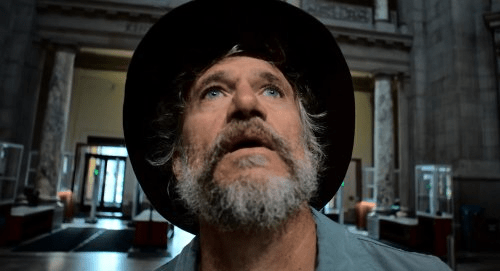
At first, though, it seems that Herzog has simply found a worthy human subject in Steve Boyes, a naturalist and researcher from South Africa who has developed much more than a simple interest in a particular kind of elephant, native to Angola but as yet undiscovered in the official record. In fact, Boyes is obsessed with the idea to the point that Herzog outright asks him if the “ghost” elephant, as the man calls it, is his white whale. Yes, Boyes says with a grin that merely comes from humoring his interviewer, there’s an element of Melville within him, but he does believe, at least, that he’s grounded his search in plain reality.
Herzog’s embellishments are part of what comes along with one of his documentaries, though, and so, of course, it’s amusing for him to make the Moby-Dick connection. It’s also entirely understandable, as Herzog—like us—is merely approaching Boyes from the outside looking in, since that’s the only way he really can humanize his subject. By doing so, Herzog is allowing a rudimentary understanding of the man, and the man himself, by digging deeper than any second or third party could, fills in the details of that understanding.
By the end of the movie, we feel a shade of exhaustion from Boyes, though that might have something to do with wondering whether Herzog has split his focus in some way upon realizing there is an entire culture in which to invest by meeting the Bushmen and zeroing in on their customs and banalities. Herzog is smarter than that, though, because even these men come to understand the obsession Boyes has with seeing the mammal. For a little while, though, Herzog does turn his camera toward them, learning much about their near-mythical origins, their language (imbued with clicks and smacks reminiscent of others in the region) and their rituals, some of which seem primitive to the filmmaker but are, in fact, rich in spirituality and tradition.
Yes, Herzog found a fascinating subject in Boyes, as well as the elephants he pursues in the wild, but he stumbles upon genuine history in real time. That alone is worth watching this documentary, of course. It’s simply icing on the cake that, every time he refocuses his camera upon his original subjects, their stories continue to take on deeper and deeper significance.
After all, Boyes’ search for these “ghost” elephants resembles a lot of our own little obsessions, with the added bonus of being able to contribute to the study of the mammal. The elephant in question might have had a direct line to one of the first elephantine genera to be encountered by the very men living on and preserving these lands from the encroachment and danger of outside threats. The threats include poachers, of course, but in one terrifying piece of archival footage, we also see as one of an endangered herd of elephants is cruelly cut down by mortar fire from a helicopter.
Herzog’s mournfulness upon seeing footage like this, though it is not communicated within his matter-of-fact speech, is obvious and reflects our own. Moments like this, though, are happily offset by, for instance, the build-up to the actual moment Boyes and his crew are able to capture the “ghost” elephant, ever so briefly, on camera. Sure, it’s a blink-and-you’ll-miss-it glimpse through the foliage of a few trees, on the other side of an outcropping, but for Boyes, it’s akin to seeing the Holy Grail—or, indeed, the white whale—right in front of his eyes.
For such a relatively simple documentary, then, Ghost Elephants packs a surprising punch because its subjects—both the humans and the research that has captured one of them—are worthwhile and, finally, much more than that. Herzog surprises us and, perhaps, himself a bit by finding and humanizing these subjects in such a concise and informative way.
Rating: ***½ (out of ****)


Leave a Reply