At the center of Silent Friend is a rather bold hypothesis, borne of pure imagination but approached by writer/director Ildikó Enyedi with a keenly humanistic eye: It is possible that plants and trees can hear and otherwise sense us, and furthermore, they can communicate with us, too. Yes, this sounds like and probably is junk science, but that’s only if we consider this on such a pragmatic level that we become cynical about the possibilities. With her anthological film divided between three timelines, Enyedi is asking us to place our trust in her vision.
That type of trust, after all, is what drives each of these stories, because they are populated by an ensemble of characters constantly asking others to trust them—sometimes in opposition to the odds stacked against them by some force wildly out of their control. Take the story that is chronologically first in this cycle of stories, one which takes place in the early 1900s at Marburg University in Germany. It follows a young woman as she becomes the first female student to learn at the prestigious university, which has just allowed women to cast off the limitations of patriarchy to seek education within their hallowed halls.
Grete (Luna Wedler) has already educated herself in the world of botany in a lot of practical and studious ways, but to learn at Marburg would be icing on the proverbial cake. After a humiliating interview with school officials, who keep insisting upon questioning her about a German naturalist’s thesis that ties plant reproduction to that of the human sexual cycle, she becomes the only woman in the class. Later, she interests herself in photography under the slightly condescending tutelage of Herr Fuchs (Martin Wuttke) and sets her sights on travel as a vessel for work.
In 1972, at the very same university, a young man and woman bond over similar work in the field of natural studies—as well as in the arena of immediate physical attraction and radical politics. Hannes (Enzo Brumm) likes to read lackadaisically in the very field, just outside the dormitories, where Gundula (Marlene Burow) is studying the relationship between plants and humans. Her set-up comprises a single geranium, which she keeps watered on a tight scheduled and attached to a device that monitors it for the reasons laid out in the opening paragraph.
Gundula believes, perhaps resolutely, that the vicinity between plant and human is of tremendous significance to the relationship between them, and she’s constructed an experiment to prove that hypothesis. Hannes, meanwhile, takes over the experiment, to his own chagrin, while Gundula is away for a few days, and this where the film’s grandest and boldest ideas flourish. What happens should not be revealed here, but let’s only say that the experiment does prove some aspect of Gundula’s hypothesis, while Hannes gets to play with the borders of science, far ahead of where Gundula ever might have thought to go.
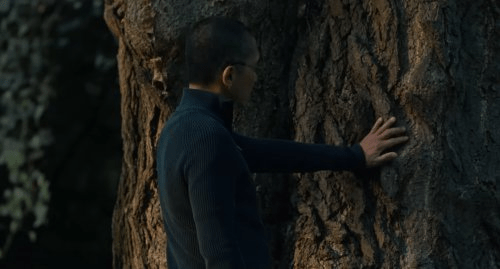
In a way, that research feeds the third, chronologically speaking, of these story lines, also taking place at that university in Marburg and also surrounding a scientist performing an experiment. He’s Dr. Tony Wong (Tony Leung Chiu Wai), who has been sent from Hong Kong to Germany with some funding to record whatever type of intelligence that a certain aspect of the surrounding plant life might be exhibiting (Léa Seydoux video-conferences in her appearance as a minor celebrity of a scientist who has a history in a similar field). It’s also 2020, with the COVID-19 pandemic just around the corner and, ultimately, a lockdown put into effect that isolates him within the walls of the institution.
In case one is thinking that the Marburg university is what ties all these stories together, that’s really incidental to the real structure that does so. It’s a gingko biloba tree just outside the window and within perfect view of the occupants of the university’s buildings. It has dominated this space since 1832, suggesting that many other stories could also reside within these halls and dormitories, and Enyedi’s point overall seems to be that this tree, in its own way, has observed and retained everything that we and it see throughout this movie.
That, anyway, is the implication by the time these stories reach their respective ends—which, for the record, are not “ends” by any usual means but simply points where Enyedi has chosen to cease her stories, even as they more than likely continue offscreen and even with regard to this particular tree. Our required patience within this serene tale makes the intentional lack of clear resolution perhaps the boldest tool in Enyedi’s arsenal. On the other hand, each story does end with some aspect of the tree’s relationship to the human subjects a clear and concise realization, which means that the filmmaker’s whole point is still just as clear, just as concise and just as finite as if it had been a solid resolution.
The intention here is a constant reinvention and a certain reconfiguring of how we process the stories we experience and how we consider the world around us. Every performance here is dedicated to that idea, from Wedler’s fierce determination to Brumm’s playfulness and Leung’s considered calm. The cinematography, courtesy of Gergely Pálos, is meticulous, with different styles in each era (black-and-white with Grete, sterile gray with Tony, a hazier look with Hannes), and Károly Szalai’s editing, which often involves shifting between the timelines without warning, is precise.
It is debatable whether all of this comes together by the end to create some sort of cumulative effect, especially considering that bold but strange choice to leave these threads open-ended. It doesn’t matter too much, though, when the results are as absorbing and dense as a film like Silent Friend.
Rating: ***½ (out of ****)


Leave a Reply