For the Allied powers locked in total war against their Axis counterparts, the only true considerations that led to the landings along the beaches of Normandy on a single day in June 1944 were strategic. It was a moral necessity to liberate France from Nazi control, by any means necessary, and it was almost entirely up to President Dwight D. Eisenhower to determine the timing of a surprise attack from the largest armada of warfighters in the history of military action. For one man, though, the consideration that was most crucial might also have been, to some of these other people, secondary or even tertiary in importance: the weather on the day in question.
As such, Pressure (a title that quickly takes on two meanings) comes from the stage play of the same name by David Haig, who has co-adapted it into a screenplay. That means this drama, set in the heat of the Second World War, only features the battle in question as part of a final montage that, one supposes without having seen the 2014 theatre production, is a flourish on the part of director/co-screenwriter Anthony Maras. All the action, as it were, takes place within the interior of Southwick House in Hampshire, England, at which Eisenhower has set up a makeshift military command.
Those dual meanings of the title are obvious, of course: Eisenhower (Brendan Fraser) is under an enormous amount of pressure to launch the incursion upon Normandy’s captured beaches on a Monday, June 5th, when his forecaster, Col. Irving Krick (Chris Messina), has assured him the weather will be sunny skies and an imperceptible breeze. As for the atmospheric pressure, Krick and Group Captain James Stagg (Andrew Scott), the protagonist of the piece, disagree mightily on that important bit of meteorology. If they wait too long, the element of surprise is lost, and that is all that matters, at first, to Eisenhower, on whose shoulders every bit of this falls.
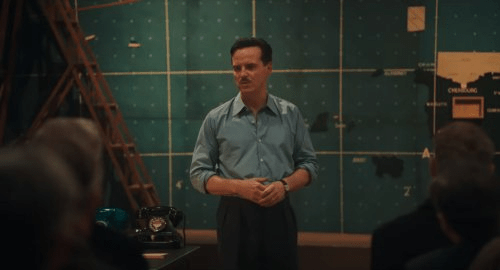
The staginess of this drama should be making itself quite clear by now, because, indeed, once the deliberations about the date on which to launch begin, we do not leave this manor house or its grounds, which include a small chapel and only a few rooms in our tour. There’s something freeing in that decision, though, because it means we are able to focus entirely upon a series of strong performances from these actors, playing intelligent men (and one woman, in the case of Kerry Condon’s strong-willed and very Irish Kay Summersby, the personal assistant to Eisenhower). At the forefront of this is the intentionally standoffish and no-nonsense Stagg.
Scott’s performance here communicates the businesslike nature of an expressionless man who enjoys only the long hours of deliberation and not the needless distractions of celebration and drink in which the other men partake. He has a very pregnant wife at home, and as this in itself is stealing him away from the approaching due date, he rather has two reasons to see it through quickly. The performance comes down to a series of speeches, always kept a decibel or two lower than technically “impassioned,” until a final plea for attentiveness to the wrath of Mother Nature finally causes him to raise his voice.
Fraser is solid as the future 34th President of the United States, proving his mettle in leadership while also internally frightened and insecure about every decision he makes. Messina is quite good as Krick, who positions himself as Stagg’s foil with his swagger and stories about Hollywood productions. As Bernard Montgomery, the Field Marshal on the English side, Damian Lewis adopts a high, reedy voice but refuses to provide a simple caricature of British snobbishness in a sharply calibrated turn that sometimes steals the screen from the others.
It’s important to note these performances, if only because Maras dials down anything like a directorial persona for much of this, preferring static shots of rooms filled with workers, montages of the work they are doing and, when the actors are really cooking, close-ups at crucial moments. Maybe that means the direction here is “stagy” by the clinical definition of the term. It also, though, proves itself to be the only approach that might have worked with this heightened, claustrophobic material.
A dry linearity pervades Pressure for all the right reasons in other words, because Stagg’s warnings, Krick’s dismissals, Eisenhower’s desperation, and Montgomery’s insistence upon action at the expense of everything else are all brought to life here in a way that is, occasionally and thanks to the actors,, quite thrilling to watch. It may not be much, but it’s quite enough for a sturdy drama like this.
Rating: *** (out of ****)


Leave a Reply