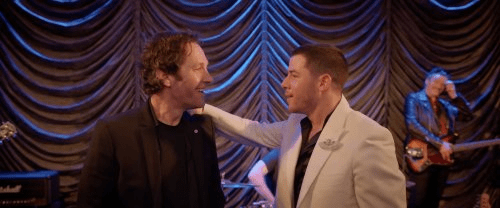
John Carney returns, a little bit to play the hits and with a new tune or two for good measure, with another tale of music, creation and creative purpose with Power Ballad. It’s about a veteran songwriter, who hasn’t written a bona fide hit in his long career, and a trending pop musician, who hasn’t written anything he can be proud of in his comparatively short career. It’s also about, more existentially, a philosophical debate between the two careers, which suddenly careen toward a conflict that neither man could have anticipated.
On one side of the debate, we have Rick Power (Paul Rudd), the songwriter, who long ago dreamed of playing at Madison Square Garden but was rudely interrupted on that road by a crazy little thing called falling in love. It was meant to be a simple tour stop in Dublin, but a chance meeting with Rachel (Marcella Plunkett) turned to a now decade-plus marriage and, with the arrival of their daughter Aja (Beth Fallon), fatherhood. The old band fell apart, and a new one, which now offers jukebox hits for wedding parties, was formed.
Carney is smart with this screenplay (co-written by Peter McDonald), though, because there’s no trace within Rick of begrudging Rachel the life they have built together—if, of course, he even feels any sort of resentment in the first place. The dream remains, as all dreams typically do, but after so many years, even the aspiring rock star has come to realize it’s a dream deferred and accepted the new life that resulted from it. His wife loves him, and there’s as much love from his daughter as there is the smidgen of embarrassment that any child of a musician is bound to feel.
We even see a bit of the old showman in Rick early on, as he and the members of his band (the most important one is Sandy, a perennially under-the-influence dunderhead and generally good guy played by McDonald) end a set with an early single of Rick’s own. He imagines a crowd singing along and waving light sticks or flashlights as the crescendo arrives. Of course, as the illusion falls, it’s just a skeletal crowd, with most of the wedding guests having gone off somewhere else.
It’s at just such a wedding that Rick meets Danny Wilson (Nick Jonas), the pop star and the other part of that proverbial debate. He’s ultra-famous, having been in a boy band for years and just recently decided to go solo. His manager Mac (Jack Reynor) is looking for the single that’ll announce his legitimacy as an artist in his own right, but Danny is serious about this move in ways that can’t be suggested by the PR machine in which Mac intends to enclose him.
That’s when the two men meet, with Rick and his band (called The Bride & Groove, by the way, which is a great name) hired to play a wedding at which Danny, through a childhood friendship, is a guest. A night of booze and pot leads to some fumbling songwriting and the birth of a new tune, courtesy of Rick’s lyrics and some offhand ideas from Danny. Six months later, Rick hears that song, now a smash hit by Danny, on the overhead at a strip mall.
Obviously, that means a bit of intellectual property theft, but a simple conflict arising from this is not what Carney is interested in exploring. It’s more that, for each of these men, the song (which is a very good one, by the way, as can be expected from a songwriter like Carney) comes to mean something significant and certainly life-changing. For Danny, it means the potential of the stardom he’s been looking for, but also an excuse to break away from the boy-band priorities and history with which everyone still associates him (some pictures of the real Jonas standing alongside his actual pop-stars brothers, gives us an idea of what the group might have been, but no more than an idea, thankfully) and a way to confront his friend-or-something-more Marcia (Havana Rose Liu) about his feelings.
For Rick, it’s a way to connect to the part of his past that might have contributed to the song, though the specifics of that are details to be left to the movie itself. Both men need the song, both men had something to do with what it became, and although the conflict here leads to a slightly silly third act, in which Rick and Sandy plot “revenge” against Danny, a kernel of truth and real wisdom still informs the proceedings. It all leads to a genuinely affecting final montage, in which dual performances of the song are intermingled with a minor revelation that provides a real sense of closure.
Rudd and Jonas both excel as men of different generations and backgrounds, but with the same creative drive at the center of their disparate personalities. Power Ballad really understands both of them, and even if it occasionally gives into formula and familiarity, the understanding is more than enough.
Rating: ***½ (out of ****)


Leave a Reply