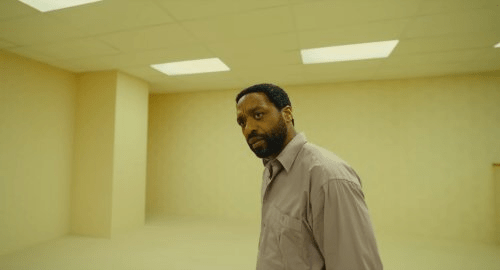
Humans often bury trauma and insecurities somewhere in the back of their mind, only allowing themselves to be haunted by it when they are not fully aware of doing so. In Backrooms, this manifests itself as an endless and impossible space in the subfloor showroom of a furniture store, where anything could—but often doesn’t—peek out from within the shadows of a crawl space or behind a wall or a slightly opened door. One character describes the effect as this impossible space dredging up a half-recalled memory, but poorly, like having only seen a dog once, many years ago, and been asked to draw one.
One might recall a web series from a few years ago, comprising 22 episodes that ranged from less than a minute to more than 45, that detailed misadventures within a similar impossible space—alternating between the “found footage” of some poor souls who got trapped within it and informational videos about how the “backrooms” came to be. Theories ran rampant, sparking videos as long as the series altogether, and eventually, there was an actual explanation. It was an intriguing one, too, subtly attached to a specific period in American history but also borne of neutrally good intentions.
It would be a double act of entering “spoiler” territory, both for the web series and for Kane Parsons’s film, to reveal what that explanation was, mostly because it was such a fascinating surprise and because the movie—almost by nature—does not ultimately traverse that particular territory. Parsons, who returns to direct after orchestrating the series (itself a twisted take on a virally popular internet post from a few years prior), and screenwriter Will Soodik have other things on their mind with this feature-length take on the film. The first major difference is that it centers upon two characters who, at the start of this story, have nothing to do with whatever caused the “backrooms” to be the way they are.
One is Clark (Chiwetel Ejiofor), a furniture salesman who once dreamt of life as an architect before a series of personal disappointments and marital drudgery. He discovers the backrooms one night, following a string of mysteries surrounding the electrical grid that runs his store—a dying one, by the way, with no foot traffic even as signs display that everything in the store is on sale. Our amusing introduction to him involves filming an advertising campaign as a peg-legged pirate, and by the way he’s hobbling and panting and barely functioning, it’s clear he’s had his video technicians (played by Finn Bennett and Lukita Maxwell) at it for hours and hours.
The other character is Mary (Renate Reinsve), who is Clark’s therapist. She has her own backstory, revealed in mostly wordless snippets, of a strict mother who suffered from severe mental health issues. She doesn’t feel she’s making much progress with Clark, a recovering alcoholic, during their sessions.
The personal lives of these two do ultimately matter in ways that should not be revealed here, but of course, it all comes to a head in large part due to the rooms, which have been accomplished entirely by way of a physical studio space, a few dozen into the thousands of square feet. It begins as office space but leads into hallways and entryways, with each detour featuring its own exit into other spaces that all begin to look the same—except when they also feature mirrored stop signs in the middle of a room or chairs, couches and desks melded with the floor and ceiling. The place is completely empty, except for the sound of footsteps, the presence of a camera (behind whom someone must be watching, surely) and the discovery of a duffel bag filled with security badges.
The effect is a disconcerting one for several reasons, but the most immediate of those reasons is that it seems to be a place conjured by the dreams of an anxious person. Its sickly yellow wallpaper almost invites one to disappear within it, just as Clark discovers the doorway to be an invisible gap in the wall of a particular room. We’ve all likely dreamed of impossible spaces such as this, and considering there are only a select number of layouts for office space, it’s likely such dreams looked a lot like what Parsons and production designer Danny Vermette have constructed here.
Digging beneath the surface is Parsons’s and Soodik’s ultimate goal, and at first, that’s an admirable one, mainly because the performances from Ejiofor and Reinsve clearly communicate their characters’ plight. Once the third act, in which Mary—after a lot of prodding from Clark—finally enters the rooms, forces a literal confrontation between these frail humans and their fears, the proceedings take on a strange effect. It’s not that the movie underwhelms necessarily, but the backrooms themselves take second billing to the warfare, both of the psychological and (with the introduction, a bit too late in the game, of a creature with horribly familiar features) literal varieties.
On a conceptual level, it’s the kind of crazed ambition we want from young, go-getter filmmakers like Parsons, who is most assuredly headed to bigger and better things after a massive creative swing like this one. The main lesson of Backrooms from a filmmaking perspective is to absorb the misses that must inevitably come with those big swings, and here is a movie with the guts to meet the moment.
Rating: *** (out of ****)


Leave a Reply