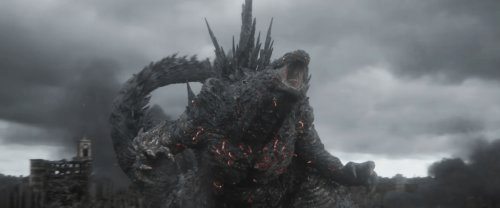
The big guy finally becomes a metaphor mostly about himself in Godzilla Minus Zero, which confronts the whole reason for his existence in some subtle—but mostly bombastic—ways involving a particularly pointed flashback somewhere around the halfway point of Takashi Yamazaki’s sequel to his 2023 film. Godzilla Minus One was mostly about giving us a new vision of the giant lizard with the fiery breath, and it did a pretty good job of doing that—within the context, of course, of a human story that both mattered and also felt a few degrees too melodramatic to matter more than it actually did. The point was the sincerity of that story, which is occasionally the point, too, of this sequel.
At least, the human story here matters as much as it can within the context of the one about Godzilla and the battle that will ensue, sponsored by those humans in a truly desperate act, between him and another massive creature as the film reaches its ambitious climax. There’s so much going on in this plot, from a screenplay by Yamazaki that seeks to up the ante on every complication that already existed in the wake of Godzilla’s presence. Out of the rubble arrive a few conflicts, and while one of those is basically what we expect—that other massive creature, which only grows in size and appendages as it inflicts its damage—the other one is so insane as to call attention to itself in a few ways.
It’s a little funny that this more holistic treatment of Godzilla, which confronts the beast in its natural habitat once again, has started to resemble in some ways the Americanized version that has been keeping time with these two movies in the past few years. That second complication really does seem to be the type of fantastical contrivance that would dictate a need to introduce a second monster and a newly revitalized fight. This is not a criticism, by the way, but merely an observation of just how much weirder and more ambitious this sequel is in comparison to its predecessor (in a way, too, that reflects the existence of, really, any sequel to the 1954 masterpiece, which stands alone as a self-contained story).
As for the human side of things here, it picks back up with the kamikaze pilot Kōichi (Ryunosuke Kamiki) and his now-wife Noriko (Minami Hamabe), who have taken on Akiko (Sae Nagatani), the orphaned baby she rescued in the first film, who has grown into a young girl. One might recall a shockwave blast that seemed to have punctuated Noriko’s involvement in the story from the last movie, but the reunion at the end of it assuaged those fears of her loss—though the wicked black bruise on her neck was, indeed, suggestive of something unnatural about her unlikely survival. Let’s just say that it’s connected to that second surprise and leave it at that.
Elsewhere, the sudden presence of the second monster, named Ghidorah and taking on an appearance that seems closer to a dragon than anything else, alerts Dr. Noda (Hidetaka Yoshioka), now the director of a disaster-response bureau of the Japanese government, to the need for a new plan of attack. This beast, though, shoots electrical fire from its mouth and regenerates with absurd ease and speed (eventually in a way that alters the number of heads it possesses), and no weapon or bolt of lightning seems to work. At this point, any pretense of the human story mattering more than as a clothesline on which to hang a bunch of action set pieces all but dissipates.
That’s been the way of things for these movies and the ones they inspired for ages now, and it’s kind of nice when the movie gets all the human stuff—which largely consists of endless discussions surrounding what to do, how to do it and how to feel about how they’ll do it—out of the way to get to the sight of a couple of massive creatures fighting each other. Yes, there is effective human stuff along the way, including at least one wrenching and avoidable death. On the other hand, the potential dynamic between Kōichi and Noriko is simplified once her place in the narrative has been secured (spoiler: it’s primarily to serve as a plot device of wobbly logic).
These visual effects, though, are fearsomely, well, effective, bringing Godzilla to intimidating life once again (this could never have worked with an actor in a rubber suit, although one supposes that might have been a fun route in a cheesy-bad way) and doing the same, but to arguably a greater degree, with Ghidorah, an occasionally terrifying addition to this fledgling series (the end of the movie, by the way, all but confirms that there will be another one). The final battle is basically a third of the movie in length, and it’s a dynamic sequence, as the humans try various methods of stopping Ghidorah, before wisely getting out of the way to let Godzilla do his thing.
Circling back to how which this particular version of Godzilla is a self-reflexive metaphor, let’s just say the backstory of a biologist (played by Min Tanaka), who survived the atrocity at Hiroshima, is seen in a flashback and, for what must be the first time in this series, treats the event as more than just a thematic backbone. That stretches the metaphor quite a bit and rather dubiously, but even so, Godzilla Minus Zero fits the bill as an exciting second entry in a rebooted series that has legs and a lot of fire in its breath.
Rating: *** (out of ****)


Leave a Reply