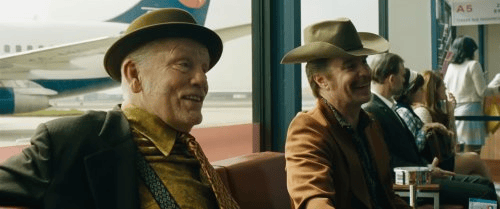
Wild Horse Nine constantly teases the kind of movie that it turns out not to be, and that, undeniably for the better, includes the very specific type of familiarity that its initial premise seems to suggest. The film stars John Malkovich and Sam Rockwell as a pair of aging professionals, sent abroad on a mysterious mission, in which the actual outcome is so that one of these men can kill the other one. One could be forgiven for pointing out that writer/director Martin McDonagh hopes we won’t see the obvious connections between this plot and that other one, if only because the action here takes place on an island off the coast of Chile and not in a picturesque town in Belgium.
If the similarities are undeniable, then it comes as a sigh of relief to realize, as we move through this ambling narrative with its primarily comic overtones, that McDonagh has something else—if not really something more thoughtful, at the end of the day—in mind with this buddy comedy that also happens to feature a specific political backdrop. The year is 1973, which means that the military coup d’etat is only months away (and on a date in the late summer that is always jarring to remember for this American), and these two men are merely on vacation to Easter Island—though, as one of them points out and even jokes at one point, it could easily be that they were asked here for the other reason. The plot is all about how thankful everyone should be that it’s mostly just a vacation.
On two levels, the thankfulness extends to the actual reason for Chris Carlisle (Malkovich) and Lee Chesterfield (Rockwell) to be on this trip—beyond the understood side mission for Lee, which the operative would probably rather not carry out. The sad tragedy of Chris’ life, though, is that he’s rather losing himself as he slowly dies from cancer. He’s forgetting things, such as the secrets he has sworn never to give away and the prohibition he should exercise in not revealing the secrets he does remember.
The man, after all, was involved in a lot, and in a particularly wry moment, he at least remembers enough to retain plausible deniability about the events of November 1963 in Dallas, Texas. He is the last man anyone should want out and about, babbling away the relationships that have flourished since the end of the Cold War, and that’s why, as clear as day, his and Lee’s commanding officer “MJ” (Steve Buscemi) orders Lee to do the unfortunate. Some part of Chris, deep down but surfacing slowly amid the loss of his mind and wits, knows this, though, and that’s where the broken heart of this otherwise rather slight comedy resides.
Not much actually happens in this movie, which is another reason that it subverts our expectations of it. A movie surrounding the elicit espionage and secretive activities of the CIA, while our protagonists are waiting around for something to be done on this island, certainly sounds like it’s headed in a certain direction—a lot of action, in other words, or at least something of more significance than what happens here. The good news is that this gives Rockwell and especially Malkovich (who weaponizes the staccato of his speaking style to great effect throughout) the opportunity to dig into characters who are richer and deeper than what we might anticipate from our introductions to them.
The depth of their relationship goes a lot further than their professional priorities around each other, for instance, as we learn that Chris has almost nobody in this world but the man riding next to him on planes and in cars (Tom Waits appears as a character who could dispel this notion, if not for all the ways he doesn’t when the time comes). Lee has a wife (played by Parker Posey), who doesn’t even care enough to hide her infidelities, and a couple of kids at home, and he winds up learning the hard way what such connections to a home life might be worth in this line of work. Since we know what a cancer-related and dementia-enhanced prognosis might mean to the Agency, we’re obviously struck by how cynical this movie is beyond the relationship at its center.
A more specific plot does eventually materialize when the two men meet two young students, Monica (Mariana di Girolamo) and Alicia (Ailin Salas), with a set of strongly held political beliefs, informed by the times and the political landscape. Where this part of the movie goes, as Chris’ forgetfulness pivots toward paranoia as the only certainty of his new existence, should be left for the viewers to discover. The twist is a significant one, which finally does inject something like a sense of mission into the movie’s meandering.
That it comes together at all, with a final scene between Malkovich and Rockwell that expertly melds the wry comedy with something far more sincere and even touching, is an accomplishment all its own. Wild Horse Nine is fairly insubstantial in relation to some of the more severe developments of its plot as it goes along, but it works often as a showcase for its two great lead actors, who understand instinctively—because they are great—how to calibrate this material.
Rating: *** (out of ****)


Leave a Reply