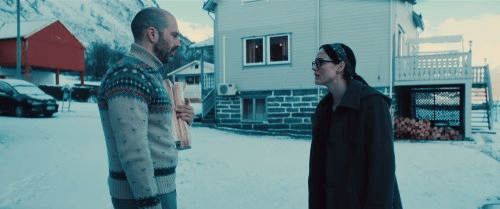
So much of the drama in writer/director Christian Mungiu’s Fjord surrounds the definition of terms and the cultural and social context in which they might be used. Children arrive at school with mysterious bruising where it could not be if the source was only roughhousing or intense gymnastics, and authorities are made aware, launching an investigation into parental conduct. Does an admonishing slap to the rear-end constitute physical abuse, and for that matter, is a “slap” the same as a “hit” or, as in one case of curious word choice here, “kick?”
From this rather delicate premise, Mungiu has spun a thoughtful drama about all sides in this debate, and while the screenplay would seem to center the two perspectives that are the least useful ones—those of the parents being investigated—it should be stated up front that the filmmaker is also being smart about its various points-of-view. The parents have established for their children a household built upon strict and austere religious principles, which, of course, is their right in Norway, where the film is set. The system that oversees the safety of children, though, is just as rigid, if not more so, and possibly governed by even more rules and regulations.
Once a complaint has been determined worthy enough, for instance, to rise to the level of an investigation by the Department of Child Protection in this small village, set beside the sea inlet of the title, the child or children are taken until an investigation has been properly launched and a decision has been made in the local family court. That’s the legislation, and in all but the smallest details, it overrides the religious considerations that might favor Mihai (Sebastian Stan) and Lisbet (Renate Reinsve) in their fight to regain control of their five children. The placement of those children in various scenarios of Child Protection custody or foster care is, the court maintains, for their own good.
We don’t entirely disagree, because, over the course of this patiently paced drama (which runs nearly two-and-a-half hours), we observe how Mihai, a Romanian engineer, and Lisbet, his wife who is returning to her native country, operate as parents. Each of them gives us a reason to be sympathetic at first, because the recent move to Norway has occurred in the wake of the deaths of Mihai’s parents. All the Gheorghius want now is a sense of stability, which they have found in their faith, their fidelity to each other, and, now in their new home, in their friends—specifically, their next-door neighbors, who take on increasing significance as this story moves forward.
Mihai is a quiet and observant man, except for his few outbursts and something behind his eyes that suggests a coiling anger could strike at any moment. Lisbet is plain and equally quiet, but the woman is clearly in love with her husband. Their children include the two eldest, Elia (Vanessa Ceban) and Emmanuel (Jonathan Ciprian Breazu), and three younger ones, including a recently born infant still being fed his mother’s milk straight from the source. The neighbors are the Halbergs—Mats (Markus Tønseth), who also happens to be the headmaster of the local school, his attorney wife Mia (Lisa Carlehed), his daughter Noora (Henrikke Lund-Olsen) from a previous marriage, and the current patriarch Åke (Øyvind Venstad Kjeksrud), who is in his old age and seemingly unable to move or speak.
The catch here is that Lisbet and especially Mihai believe that their method of parenting—in which punishment is doled out as a way of teaching their children about the realities of the world around them—is also for the children’s own good, which means that the legal debate the center of the movie exists almost as an aside to its murkier morality. It might seem simple enough to diagnose a type of parenthood as “wrong”—easier, perhaps, in that legal sense—but there is also the question, in the wake of the allegations that lead to an investigation, of whether the punishment in this case is even of the type that the children themselves claim it to be. Elia and Emmanuel are sort of blank slates here, limited in their view of a world kept from them by their parents, and so the honest answers to a series of hard questions might actually be concealing less serious conclusions.
Much of the film’s middle and third acts are taken up with the procedural elements of the domestic drama that unfolds, with Mihai and Lisbet being questioned by a pair of officials (one, from the school, played by Lisa Loven Kongsli and the other, from Child Protection, played by Ellen Dorrit Petersen), hiring an attorney (played by Anne E. Kokkinn) who doesn’t quite foresee the complications ahead, and attending court hearings to determine their fitfulness as parents. These scenes are potent, though a few elements—such as a prosecuting attorney, played by Christian Rubeck, whose job it is to directly state the theme of the movie to the camera—are relatively familiar and overly literal. The film is much better in the surrounding details, like the friendship that develops between Elia and Noora but suggests something deeper or the eventual importance of Mia’s role in all this.
In fact, the film is so strong in those elements that it becomes easy to forgive the ways in which Mungiu has slightly dulled the edges of the drama to prioritize the message. Fjord is absorbing in its quiet but forceful exploration of the complexity within seemingly straightforward morality—before delivering a final scene that is wrenching in both its decisiveness and evasion.
Rating: *** (out of ****)


Leave a Reply