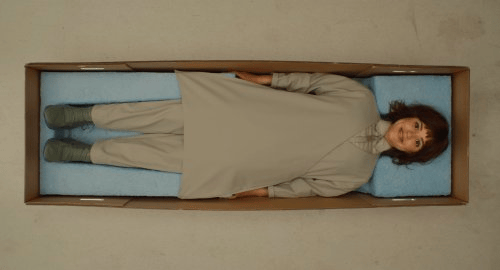
Taika Waititi’s Klara and the Sun is such a mess of tone and purpose that it’s never quite clear whether the director, who also co-wrote the screenplay with Dahvi Waller, even likes the source material on which his film is based. That is distinctly odd, given that the novel was written by Kazuo Ishiguro, a Nobel Prize laureate who must have had better intentions with this story than what shows up onscreen. Part of the movie is dedicated to a most unusual friendship that, in the right hands, might have been a delicate, touching, or even moving one but, in these hands, feels like grasping at thin air.
One minute, the film is selling us on that friendship, which is literally bought and paid for with the intention of forming that very bond, and the next, it’s just offering a lot of broad, slapstick comedy. Klara (Jenna Ortega), after all, is an “Artificial Friend,” and in the opening scenes, we learn that these AFs literally hang out in their own store and watch as customers browse the options and pick out a model for their own or others’ benefit. Well, at least, that’s what the store manager (played by Natasha Lyonne) wants for her business, although it’s looking a lot different and much bleaker these days, when a store boasting the newest models of the same robots opens right across the street.
The world in which these robots and their humans exist is one that has seen a third world war and the disappearance of the internet in its aftermath. We learn this fact quite literally by way of a line of dialogue, which is about all the interest Waititi demonstrates in wanting to explore such a world in any way. It’s not much (indeed, it’s barely anything), but it mostly provides a reason to dump us right into the middle of Klara’s story, as she begs the Sun (a source of one-sided conversation and imaginary friendship) for a new owner to present herself.
One does, literally revealed through the dust cloud in a robotic street cleaner’s wake: Josie (Mia Thalia) is a troubled girl, with an overprotective and harshly judgmental mother (played by Amy Adams) and a secret illness whose symptoms only show up a handful of times, to let us know that the mortality of this character is constantly in question. From there, the real reason for the purchase of Klara, attached as always to a 30-day warranty, isn’t far behind or too difficult to figure out. Much of the story meanders to that climactic realization, which is much more of a surprise to a clean-slate being like Klara, who comes to believe that her friend the Sun lives in a small barn atop a hill perfectly positioned upon the horizon.
If Waititi has little interest in the nuances or the subtleties of this story, that quickly reveals itself to be because there don’t really seem to be any (again, an unlikely truth, given the author of the novel). Klara is, indeed, a clean slate, played with a bright sense of discovery and niceness by Ortega but only given any deeper dimensions at the very last second, and that means the filmmakers can mine a whole lot of silly comedy out of the character’s natural naivete. That usually means a series of pratfalls or unconvincing stretches of irony (disguised as wit, as is unfortunately all too common in comedies these days) or surface-level indulgences in the small ways this futuristic society has chosen to embrace its offline limitations through a reliance upon these and other robots (a scarecrow bot, played by Jesse Griffin, introduces the possibility of a new and interesting character, but of course, he exits before that can go anywhere).
Along the way, we’re introduced to some aspects of Josie’s life, such as a tragic backstory that does inform the actions taken by her mother Chrissie and a cute relationship with a local boy (played by Aran Murphy) who clearly only wants what’s best for her. Even this angle, though, is ultimately reduced to being a device for the plot to get us to that third-act revelation about the reason for hiring Klara (Steve Buscemi has a cameo appearance as a character important to finalizing a few things about this reason). It’s too little and far too late for the movie to decide to be About Something after more than an hour of pretense, though.
This is a deeply irritating movie, in other words, because it constantly draws attention to the ways it thinks it’s being funny, only to undermine those jokes with misplaced sincerity and a lot of half-considered melodrama. When Klara and the Sun finally does something with its ideas, the result is wholly unconvincing.
Rating: *½ (out of ****)


Leave a Reply