All the son really wanted to do was to find some closure—for his family, for his father and, most importantly, for himself. That, above all else and even the tale of survival that it becomes, is the crux of the story in Whalefall, which is essentially a tale of survival but exists apart from that mode, too. Brian Duffield’s adaptation of Daniel Kraus’ novel is an often nerve-rattling and certainly claustrophobic experience, fueled by single-minded desperation, but the emotion that resonates most effusively from it might be its sadness.
This is a somber film, not one willing to give itself over to some misplaced wit or irony or whatever other form of comic relief that so many of today’s movies try to practice. In its flashbacks, we see a relationship driven by disagreements and arguments and tough-as-leather lessons from a man who has clearly seen too much of the world to find much joy in it. In its present is, well, that tale of survival, as the son finds himself much in the same position as the Biblical character of Jonah.
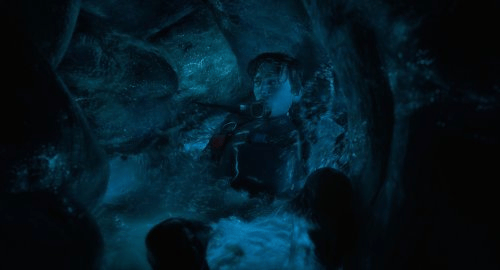
Even those unfamiliar with the book of the Bible that shares the name will likely recall at least the first part of that tale, which also involved a young man willingly thrown into the depths of the sea, “saved” by ending up in the stomach of a large fish, and vomited out after three days. With this story, Duffield (who also co-wrote the screenplay with Kraus) sort of gives us an idea of what the experience inside the fish might have looked like practically—a word that has two definitions here. The first is what Jay (Austin Abrams), whose name and the way it suggests the first letter of another one cannot entirely be a coincidence here, will literally do to escape the digestive tract of a sperm whale, and the second involves the craft put into realizing it.
Simply put, the production design (by Ramsey Avery, who was also likely in constant communication with the effects supervisors to create this visual magic trick) is an actual character here, since it’s an enclosed space, enhanced by the slimy innards of a whale’s bowels and stomach and mobile in the way it must constantly contract and contort all around Abrams. The actor, by the way, is put through the wringer, not only as a person who is himself hopefully not claustrophobic but also as a performer who must act through the mouthpiece of an oxygen tank working overtime and largely with eyes agog at the dangers that reside inside the whale. It’s consistently stressful work from the actor, complementary of the stressful environment around him.
The story is almost entirely limited to Jay’s experiences inside the whale, which happens when the sizable sea mammal picks up an octopus for its lunch, inadvertently trapping Jay in the various appendages of his diving suit (and the octopus, in an act of self-preservation that seems a little human in addition, grabs onto Jay for support in the process). He’s gone to this part of the ocean to commemorate his father Mitt (Josh Brolin), whose love of diving coincided with a mesothelioma prognosis that took a lung. Dear old dad decided he didn’t want to live if he couldn’t dive anymore and, as we see in a wordless and devastating prologue, leapt off the side of his beloved boat.
A year after the bodyless funeral, amid a silence that has not gone unnoticed by the rest of the family (Elisabeth Shue plays mom, while Jane Levy and Emily Rudd are his sisters), Jay risks everything to go and look for the body where it apparently came to rest (John Ortiz has a small but potent appearance as dad’s best friend and diving partner, who immediately clocks Jay’s reason for diving and gives him the final piece of information he needs). In the belly of the beast, Jay tries at first simply to use his own resourcefulness, but at certain point, intuition and the disembodied voice of his own father begin to guide him, with memories serving as specific instructions. For his part, Brolin brings the gruffness we expect from the actor but softens it, too, as the reason for the character’s cynical world view reveals itself to be tied to his preference for the way of water.
Some of this does become too convenient, as dad’s voice starts to shift its nature with Jay’s relationship to the reality of his situation, and even borders on a little silly, as with a sudden run-in with killer whales that sort of comes out of nowhere to introduce one too many layers of conflict atop what is already here. That matters little to the rest of Whalefall, which is wholly convincing as a survival tale and sometimes rousing as a tribute to the human spirit.
Rating: *** (out of ****)


Leave a Reply