Following the runaway success—critically, financially and at the most prestigious of awards ceremonies—of The Exorcist in December 1973, studio Warner Bros. was faced with the possibility of creating a sequel, though that was already an uphill battle: William Peter Blatty, who wrote the original novel that inspired the film, was quite sure he had finished the story of Regan MacNeil, the young girl possessed by the devil himself, and had nowhere else to go with it. Of course, a studio under pressure from public demand isn’t going to cave to explicable logic such as the unlikeliness of a story. Thus, a sequel was conceived, written, filmed and released more than three years later—Exorcist II: The Heretic.
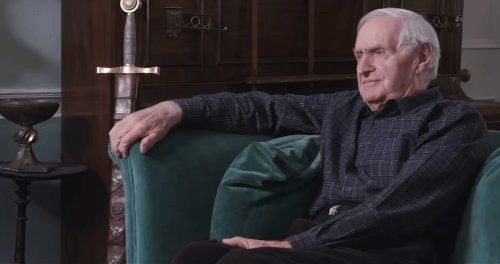
For a long stretch in its middle, there is nothing that really sets Boorman and the Devil apart from one of those making-of documentaries, usually featured on the second or third disc of a physical release, that were so prevalent in the early part of our current century. Time and the shifting priorities of studios means that we’re sort of getting the equivalent of such a documentary here, albeit at feature-length and with some detours that narrow the focus onto John Boorman, the director who was ultimately to take on the challenge of crafting a sequel to an apparently self-contained story. That, though, isn’t how Boorman approached the project, even as he read a screenplay that featured the first film’s most important character as the lead.
One of the more interesting—if not entirely successful, for reasons we’ll get to later—things that director David Kittredge does with his documentary is to acknowledge that any remembrance of a tumultuous production like the one for Exorcist II: The Heretic is probably going to become, in some way, an act of film analysis and even criticism. That’s because, for Boorman, the decision to make the film was itself an act of criticism. After all, he was no fan of William Friedkin’s original, which he concedes was well-made and intensely performed, but also deeply disturbing and not something he especially enjoyed or appreciated.
For Boorman, the opportunity to make this sequel was also an opportunity to offer a rebuttal to the original’s (as he saw it) shock-and-awe value by crafting something more human. We all sort of know how this went upon and following its release, so for Kittredge, it’s a reason to explore something else about it. For the actors and producers and artisans and film critics and admirers of the director, and for Boorman itself, it’s a chance to soliloquize about why the movie was such a disaster—with the critics and, well, in other ways.
Again, we’ll get to that last part in a minute, but it must be said that, for about two-thirds of the film’s running time, it’s a thoroughly entertaining pair of tours—first through the early portions of Boorman’s career that got him the job offer (having startled audiences with Deliverance, he was given the freedom to make Zardoz, which became infamous for its inscrutability), then through the film shoot that occurred under such agonizing conditions that it, honest-to-goodness, landed its director in the hospital at one point. We get to hear from Boorman, who seems an awfully gregarious chap and is, as of this writing, still with us (he will turn a brisk 94 this coming January). We also get to hear from others who were involved with the film, still remember vividly everything to do with the production (which is nice, considering the movie will soon turn 50), and still have pretty conflicting feelings about the whole, blasted thing.
At the top of the list on that score is star Linda Blair, who very reluctantly took the job after reading the screenplay (credited to playwright-turned-screenwriter William Goodhart but heavily edited by interfering “creative associate” Rospo Pallenburg, also an interview subject here) but had a lot of demands and conditions for her return. Louise Fletcher, who had just been met with superstardom and an Academy Award for her work in One Flew Over the Cuckoo’s Nest, remembers fondly that she took over a role written for a man because she admired Boorman. As for the part ultimately played by Richard Burton, well, Boorman wanted Jon Voight or Jack Nicholson, and most of the recollections about Burton are of his perennial tardiness and love of the drink.
This is fairly typical stuff, accompanied by a play-by-play of the film’s mandated 15-week shoot that was complicated by a series of near-disasters and that weeks-long hospital stay, but it’s entertaining because the subjects are so open and honest about the back-and-forth feelings of enjoyment and resentment. At that point, the film moves into territory that slightly over-stretches the boundaries of an actual documentary and presupposes something: That, of course, is that the film was actually a disaster on a creative level—beyond whatever its production wrought. Some of us who like the film might disagree with that, and in attempting to show all sides of the argument, Kittredge does stumble a bit within the context of exploring Boorman’s stated intentions for making the film.
Within its flaws and obvious compromises in the edit, Exorcist II: The Heretic works better than its reputation suggests, if only because of its eerie atmosphere, a great (but, here and everywhere else, underrated) performance from Burton as a priest haunted by his divine calling, and the willingness of the film to engage in some fascinating—if slightly underserved—ideas about how a new story featuring Regan MacNeil might work. That’s a bit of film criticism that Boorman and the Devil, after working so well as a career retrospective and a making-of documentary, doesn’t quite have the bandwidth to accept in the face of commonly held critical reception, but this is still a worthwhile—informative and comprehensive—movie all the same.
Rating: *** (out of ****)


Leave a Reply