If the stories of Robin Hood, that philanthropist of the poor at the expense of the rich, are only concocted legends told over campfires, of what use are the stories themselves? The predominant wisdom might be that their usefulness is tied to the message they present, which is broadly one of wealth inequality and the vigilantism of one man to bring balance. The Death of Robin Hood has a different idea, and to begin with, it involves a version of Robin Hood who murders and pillages, with barely thought about who meets the business end of an axe or arrow.
How does get from there to the vision of the man as a conquering hero? The man himself explains it to another character somewhere along the way in this story, which finds him being pursued by a very, very bad man and forced into hiding with people of the cloth. He simply wanted a different version of himself to be remembered by the people who read of his exploits and escapades, and the desire comes from a lifetime of bitterness and in the face of an empty void in which, as he also says, it’s sometimes as easy to kill another human as to prune a dead branch from a bush.
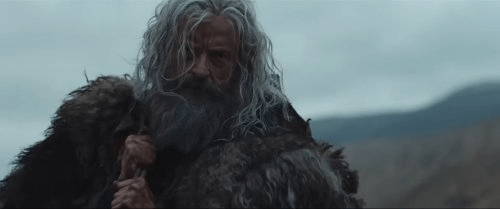
Hugh Jackman plays this version of Robin Hood with a gruff, steely gaze that reflects the way writer/director Michael Sarnoski has chosen to tell this story. The filmmaker and his director of photography, Pat Scola, have captured the landscapes of Northern Ireland, where the film was shot, with a scuzzy coldness, and that’s befitting a story that begins with a savage act of violence and only grows more desperately sad and somber as it unfolds. Jackman’s Robin Hood encounters a young woman (played by Jade Croot), dressed and attempting to pass as a boy, who believes she’s found some footing to take the aged archer by surprise.
It doesn’t work, of course, but as she lies there dying, her breaths escaping in gurgles of blood, he gives her some advice about how she might have succeeded with a bit more thought put into the tactics. Robin Hood means business here, and just a scene or two later, he proves it again, as he and his compatriot Edward (Bill Skarsgård) raid the house in which Edward’s wife and daughter are targets of violent retribution and kill everyone involved in their captivity. That includes, by the way, a young boy, though the boy, shot through the head with an arrow, does not die until he staggers to his home and alerts his family to the event.
Yes, in case it hasn’t been established, this is a brutal and rather merciless thriller of a medieval mold and attitude that recalls epics of a similar period from an older time in Hollywood and beyond. In other words, the film flatly rejects any expectation that “spectacle” means mindless motion and carnage and, instead, embraces the idea of muscular, expressive storytelling through the action itself. That means the film holds a residual coldness for some time, simply because this version of Robin Hood is so forbidding.
Following an opening act in which everyone but the devil himself is on the man’s trail, the film does retreat a bit from the violence to find Robin Hood in self-imposed exile, forced to care for Margaret (Faith Delaney), the daughter of Edward. By the way, the old friend and fellow vigilante was once called “Little John” but shed the name to protect his identity and the lives of his family. The protection did not last, and now, Margaret must flee the forces who would use her to pressure her father.
That leads Robin Hood and Margaret to Sr. Brigid (Jodie Comer), who runs a convent that doubles as a sanctuary for people in danger like little Margaret, and a leper (played by Murray Bartlett) who has some words of pragmatic wisdom to share with our so-called hero. Meanwhile, closing in on this tightknit arrangement is a young man who calls himself “Arthur” (Noah Jupe), sports a damaged and bloodied eye and has a bone to pick, to say the least, with Robin Hood for something done to him in the past. What is surprising about this whole affair is that Sarnoski entirely subverts our expectations about where the story goes.
It must, after all, be leading to a climax replete with brutal justice or vengeance or whatever word might fit the moment. The Death of Robin Hood does not, in fact, lead to any such catharsis, which would be too easy for a movie that is about, not violence, but truth and lies and the terrible power of storytelling and mythmaking.
Rating: *** (out of ****)


Leave a Reply