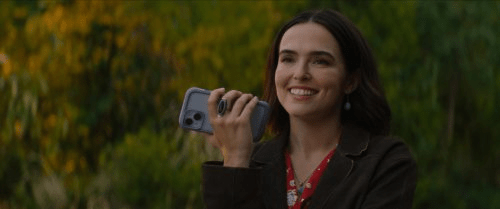
There are two main characters in Voicemails for Isabelle, a romantic drama about grief in ways that it thankfully never tries to evade. One of them is played by Zoey Deutch in a truly great performance of the kind that the movie around it will inevitably fail to earn. Indeed, she’s almost too good as Jill, a chef-in-training who loses her sister Isabelle (Ciara Bravo) to a decade-plus battle with cystic fibrosis, not long after the opening credits have announced writer/director Leah McKendrick’s name.
The filmmaker begins and ends the movie, by the way, with maybe its best observation—that Robyn’s “Dancing on My Own,” that soaring tribute, is a great song that could take on meaning for different people in different ways. For Jill, it conjures memories of dance-offs with Isabelle in their childhood, and we get a glimpse of that childhood in a prologue of such stark emotional clarity that nothing which follows it could possibly live up to the expectations it sets. Isabelle is there for Jill, a constant presence and source for venting and celebration and everyday banalities, until she is not, and Deutch plays the moment as someone in complete denial of reality until it’s right in front of her eyes.
After the death, we get the sense that Jill just couldn’t stay in place, even for the benefit of parents (played by Gil Bellows and Tanis Dolman) who might have needed her, and now, she lives in San Francisco, taking every moment she can to sit and wonder at the view of the Golden Gate bridge. She also leaves—you guessed it—voicemails for Isabelle, filled with all those thoughts and feelings and accountings of her chef training under the pompous Gilbert (Nick Offerman), her exploits with disrespectful men (including one who hosts a podcast giving women dubious dating advice from a questionably masculine perspective) and the hole in her life left by Isabelle’s departure. That’s where the story’s other character comes into the mix.
He’s Wes (Nick Robinson), who works in one of those anonymous office buildings where the occupants do something or other in an anonymous-office-building context, and Jill’s voicemails arrive on his new work phone, which inherited Isabelle’s old number. Listening to them for months on end, Wes falls in love with Jill, though initially without realizing the context of the messages. Yes, this sort of echoes a pair romantic comedies from about three decades ago, but as his soon-to-be married friends (played by McKendrick and Harry Shum Jr.) remind him in a bit of meta-reference, he’s not the kind of guy who would be played by Tom Hanks in a movie about all this.
The gimmick here is simply a few too many steps beyond the point of believability or even good taste for us to accept it without some help from the actors. Deutch nearly makes it work when the other shoe drops and Wes’ eventual plan to get to know her in person crumbles in the wake of the honest truth. Robinson does not, unfortunately, weather this storm of contrivances and conveniences quite as deftly, although that’s mostly because it’s such a fundamentally difficult gimmick to accept.
Yes, the movie forces them into a romance that’s sweet on the face of it, particularly because it allows Wes, who lost his mother some time ago, to understand why Jill would want to keep talking to her sister. Those moments, though, are even more of a showcase for Deutch than for Robinson, such as a subtle realization on Jill’s part when Wes hints at his mother’s absence on their first night of talking to each other. It’s a simple look of immediate understanding that speaks much louder than any Big Speeches to offer apologies or explanations, in order to receive the Kiss to Build a Dream On or, at least, some version of that.
Once the truth does come out, though, the film has arrived at a climax so forced in its tearful melodrama that our eyes roll almost as a defensive mechanism. Every flaw we’ve seen within Wes’ personality comes out, just as every indication of Jill as a character written to be better than the plot in which she’s stuck is tossed aside. It all becomes about the misunderstanding that must be fixed by any means necessary, even the disruption of the movie’s early good will.
Then again, we do have the last scene, which returns to the aforementioned Robyn track (just one song, for that matter, among a large number of very good ones in a pretty comprehensive soundtrack) and a pair of mirrored phone calls to convince us that maybe the movie is slightly smarter than its tortured drama might suggest. It doesn’t quite work out for the whole of Voicemails for Isabelle, but Deutch’s performance and some smart observations about grief nearly make up for the shortcomings in its foundation and drama.
Rating: **½ (out of ****)


Leave a Reply