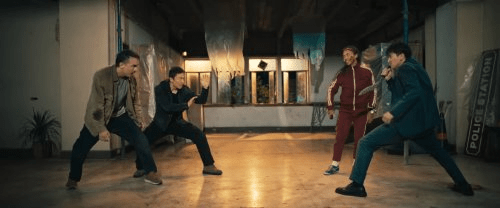
At its purest, the cinema is about motion, and few films in recent memory take that to heart more than The Furious, which, on its face, is not too far removed from any given martial-arts crime drama featuring lots and lots of brutal action. In practice, though, director Kenji Tanigaki and a committee of four screenwriters (Mak Tin-shu, Lei Zhilong, Shum Kwan-sin and Frank Hui) have crafted a film as elaborate in the points of its relatively simple story—which twists upon and within its self just enough times to offer some real surprises—as it is in giving its duet of protagonists a bunch of henchmen to kill on their way to the top of a criminal organization. There is a whiff of exploitation within this story, too, but that quickly becomes easy to ignore.
The basics of the plot do, indeed, follow two men, each with a reason to avenge themselves upon the criminal organization in question. Navin (Joe Taslim) is the husband of a reporter who went missing during her investigation (the film’s prologue depicts this, as the wife fights her way through a few hallways before coming up short in rescuing a captive, before the screen goes black to announce the title). The other one is a mystery man (played by Xie Miao), whose name we only learn in the film’s final scene, and his daughter was taken by the same criminal ring.
That detail offers a hint about that slightly exploitative nature of the plot, because the organization deals in the trafficking of children, and these men are particularly heartless in the methods they use to terrorize those children. The first time we see “Father,” as the mystery man is credited, pursue the captors of his daughter, we learn two things. One is that the bad guys have no problem trying to deter Father from winning back his child, to include dangling her inches from the ground upon which they are speeding through the streets in their vehicle.
The other thing is that Tanigaki and action director Kensuke Sonomura mean business when it comes to the sheer propulsion of the action sequences here, because we haven’t even reached the hand-to-hand combat and have already been treated to the type of car chase that redefines the cliché. Well, it’s actually sort of a misnomer to suggest that this is a “car chase,” if only because the captors are the only ones in a vehicle during the chase. Father runs after it and, for a shocking amount of time, keeps up with the car on foot.
It’s only after the first bit of hand-to-hand combat, in which the participants engage while the car is speeding down those streets, that the villains very slightly gain the upper hand and Father is forced to track down his daughter through less physical means. Yes, this is a common trope in such movies, but Xie’s precisely communicated desperation and obviously convincing physical performance are more than enough to elevate the superficially familiar material. The same goes for Taslim, whose Navin, somewhere deep down, seems to have accepted the worst about his wife but will nevertheless never give up.
From here, it’s a simple game of watching as these two men, at first separately and eventually together (after a small fight between the two, borne of misunderstanding, features the actors almost moving too fast for the camera to capture it), fight their way to the top of the criminal food chain. Yes, this is an excuse for elongated scenes of elaborate hand-to-hand combat. Yes, the movie proves that that’s quite enough to sustain nearly two hours of movie.
The explanation is quite simple: These sequences of combat are nothing short of thrilling, and several moments are downright transcendent in how they are a tribute to that old truth about cinema and movement. It’s not just that Navin and Father punch and kick and pummel these men into a pulp. It’s that Tanigaki and Sonomura film the fights with a combination of fury and grace, as well as a heaping of righteous anger.
As for the other players in this plot, they are the villains, full-stop, and what a refreshing feeling to have two villains who are unrepentantly remorseless and obviously, mustache-twirlingly evil. The main henchman is played by Yayan Ruhian, whose involvement in another ultra-popular martial-arts action drama is not at all a suggestion of what this character (who wields a bow-and-arrow as long as most men are tall) is capable of doing, and the Big Bad is played by Joey Iwanaga, whose character’s introduction as the villain is banal—only to be reiterated in a scene of the film’s most shocking violence, because it levels the playing field via a massive twist.
If the film barely pauses for anything other than body-bruising and bone-crunching action (a minor subplot follows the mostly useless and corrupt police, except for one officer who decides to grow a conscience), that’s fine in the long run, because we’re here for said action. It all leads to the final fight in The Furious, a four-way brawl between a pair of fighters each, and even then, Tanigaki imbues both surprise and a bit of subversive humor when a fifth participant joins in, playing both sides of the conflict.
Rating: ***½ (out of ****)


Leave a Reply