It’s been a couple decades now, but at the beginning and again in the middle of his filmmaking career, Steven Spielberg proved himself quite enamored by the idea of life on planets other than Earth, and in some ways—though not hopefully—Disclosure Day feels like his last word on the subject. He once gave us a close encounter, a boyhood friendship with an extra-terrestrial and even a world at war (and that doesn’t even count an ever-so-brief rendezvous with a certain adventuring archeologist), and now, the great director has fashioned a story—alongside screenwriter David Koepp—that takes place long past the point at which extra-terrestrials landed on Earth. A man has proof of human complicity in a cover-up, and agents of the government are after him.
Spielberg’s film works a bit better when it’s focused on that latter element, which is to say that, for a long time, this is a chase movie of the dynamically propulsive variety and a classically structured blockbuster in a sense that the term has not meant for quite some time. This is the director, after all, who essentially gave us the blockbuster in its modern form. The phenomenon of the summer event picture has changed quite a bit, what with the postmodernist advent of cinematic universes and even multiverses, but it’s refreshing to receive a reminder of the old ways like this film, which marries spectacle and intimacy with thrilling effect.
This is also to say that the film stretches a bit in the thematic department to find something to say about extra-terrestrials, their collision with humans and everything that has happened since such an event, but that’s almost by design within Koepp’s screenplay. Even at nearly two-and-a-half hours, the film barely pauses to consider the ramifications and implications of its own plot until the final 20 minutes. It should not be considered so much a flaw as, again, the design of the story that, as soon as a lot of those ideas open themselves up to consideration, the film is reaching its conclusion.
The only caveat it provides, perhaps, is, once again, that it means the movie functions primarily as a genuinely exciting blockbuster from a master of the form. Indeed, great plot structure is underrated within such a context, and here is an example of truly great structure. We’re thrown right into the middle of things, as the man in question, a whistleblowers, makes away with the information he was once paid to protect—that life beyond Earth was discovered and has, both systemically and systematically, been covered up.
The deeper truths within the evidence stolen by Daniel Kellner (Josh O’Connor) should, of course, be left for viewers to discover, but they are genuinely shocking, frightening and quite devastating, once the full picture comes into focus. He knows everything by now, and he’s even stolen a particularly fearsome object that, upon seeing it, his foes allow him to take, along with the evidence itself and his previously kidnapped girlfriend Jane Blakenship (Eve Hewson). Any further pursuit of Daniel and Jane, says mysterious ringleader Noah Scanlon (Colin Firth), must take into account the presence of the object.
Even what the object does carries with it a whole host of qualities that could have fit a handful of MacGuffins, all combined into one: It is a source of information, as well as communication, and can be used as a weapon of sorts, with a jarring effect Spielberg just needs to let us see once to be conveyed. As this is a well-rounded blockbuster, let us only say that it can also be used for some sly physical comedy somewhere around the start of the third act. It’s an all-inclusive device of incredible power, but also only a means to an end, as the other half of this story will fill out in its details.
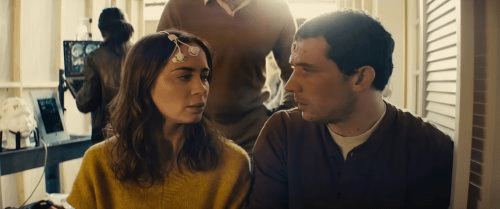
Margaret Fairchild (Emily Blunt) is the weather reporter for a news station in Kansas City, Missouri, always prone to nervous energy and a desire to uproot herself and her boyfriend Jackson (Wyatt Russell) and move. Out of nowhere, Margaret discovers an ability to read the thoughts of every living being within eye contact, from birds to Jackson to the operatives sent by Scanlon for nefarious purposes involving kidnap. She senses Daniel out there somewhere, and a viral video of her speaking some alien dialect on live television alerts him (who can understanding the strange language) to her presence, as well.
So, yes, the film becomes a chase film on two levels, as Margaret hurries toward wherever Daniel might be at any given moment (with both of them urged on by Hugo Wakefield, a dissident former member of Scanlon’s crew played by Colman Domingo) and Scanlon’s men on the trail of them both. A few action sequences prove this, such as a near-miss with a train that manages a tremendous amount of suspense in a short amount of time and, especially, a vehicular escape from a dilapidated safe house in which both protagonists sort of bumble their way to safety. Spielberg, though, doesn’t need action to dictate why the film is so very exciting.
That’s also in the debate that forms between the suspense sequences, as Daniel represents a pragmatic faction of the populace starved—as Hugo puts it—for the truth and Jane, once a novitiate who lost her calling, argues that the balance between pragmatism and faith will be upended. Spielberg, by the end of Disclosure Day, makes the argument that we can have it both ways, which is exactly that brand of optimism for which he’s known, but most importantly, he also reminds us of his unequaled skill as a technician of the modern blockbuster.
Rating: ***½ (out of ****)


Leave a Reply