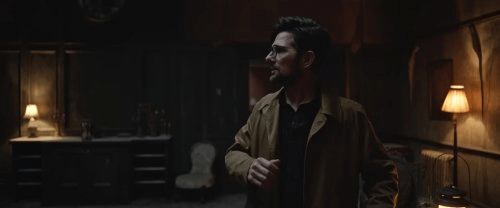
On the surface, it doesn’t seem like a whole lot is happening in Hokum: A man arrives at a lonely inn in Ireland and discovers that it is possibly haunted by some strange force that traps him in a single room for a surprising portion of the film’s runtime. Writer/director Damian McCarthy, though, opens the movie in a fashion that is wholly unexpected—with a father and son, stranded in a desert with no water or resources, trying to break open a glass bottle inside of which the key to their rescue may reside. The filmmaker also returns to this setting at the very end of his film, which mean it’s technically a framing device of some sort.
That obviously means we need to pay attention to some of the details of that whole scene, which is immediately revealed to exist within the mind of the protagonist, a writer struggling to finish a book series of which these are, it seems, the main characters. He’s Ohm Bauman (Adam Scott), whose name might be up there in the canon of great author names, and his mission in Ireland is to spread the ashes of his deceased parents at the spot where they celebrated their honeymoon many years ago. Ohm is also quite resentful of his own fame as a writer, as we learn when a local recognizes him and tries to stir up conversation about the end of the series, which is nigh.
Maybe, Ohm says, he’ll just leave the series open-ended. That in itself is almost a warning about what to expect from this movie, although one shouldn’t take this advice as a hidden spoiler of any sort. On the contrary, this movie’s ending is so subtle about its finality that one possible reading very well could be that it is ambiguous.
Obviously, a lot is actually going on here, and it’s sometime during the film’s extended second act of unintentional captivity, when Ohm finds himself locked in a mysterious room inside the inn, when we realize just how much complexity is layered over the surface of this chilly, extraordinarily unnerving and densely atmospheric mystery about the disappearance of a young woman. This is not just any young woman, but one in whom Ohm had confided some of his tangled past, before she confided in him about the many mysteries beneath the idiosyncratic surface of this place. When she turns up missing, the question becomes what happened to Fiona (Florence Ordesh), the pretty and kind bartender with whom Ohm struck up his conversation.
The content of that conversation is at the center of the film’s ultimately broken heart, which slowly peels away the supernatural bouquet to reveal a thoroughly human nature to its horror, its scares and its techniques for delivering both of those completely disparate things. Yes, it’s getting into the weeds a bit to discuss why “horror” and “scares” are separate, but this is a movie that consistently proves why it’s important to do so. The scares here come from things that go bump in the night and within the hidden compartments and hallways and dungeons of an unassuming place like a lonely inn.
McCarthy has expertly devised those scares to be maximally effective in their swift and immediate impact upon us, and in fact, he regularly achieves this by not cutting away from the build-up of a scare as quickly as the genre has conditioned us to expect. There is a devious sense to the achievement here, because the director revels in the game he’s playing with us, all while refusing to play any games with our emotions or intelligence. The horror of the movie, though, is a different story entirely from the genre technique on display.
That brings us to the actual plot, in which Ohm—after some time away for reasons that are truly a shock to the system—returns to the inn to discover that Fiona has gone missing. Is the culprit Jerry (David Wilmot), a mushroom-consuming hermit who has always been the only suspect in his own wife’s death, or someone else who might have good reason to pin it on him? What answers, for that matter, lie in the honeymoon suite, which is always locked and for which there is only one, stolen key?
It’s important, of course, to remain coy about the actual layers of this mystery, but let us say that truly shocking revelations reside in that suite, as well as in the surprising levels within the house, each of which seems to have clues that only raise questions of their own. A diabolical sort of logic drives this story, as does the sympathetic, against-type turn from Scott, who always seems to play characters defined by their savvy idiosyncrasies. Here, the actor is exceptionally good in a largely reactive, withdrawn role as a man whose own secrets are enough to devastate once we learn them.
Then, after all this, Hokum still returns to that desert and that father-son pair, whose journey comes to an end much in the same way the film does. It would be criminal to reveal anything specific or even vague about the conclusion, but it involves a bit of cruel irony on two levels, involving answers tantalizingly just beyond the characters’ and our reach.
Rating: ***½ (out of ****)


Leave a Reply