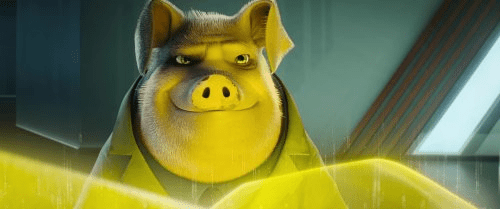
Animal Farm is an adaptation of the George Orwell novella, and it is not at all a screen version of that essential school-aged text. As the saying goes, both things can be true at once, or at least, that’s what screenwriter Nicholas Stoller truly believes about a story that has transformed from a wartime allegory about the horrors of Stalinist Soviet Union to a fairly simplistic fable about capitalistic corruption. It’s also an animated movie, although that’s probably to expected in this era when such stories are simply easier to bring to life that way.
As for the effort with which director Andy Serkis and his team of animators have executed their vision, it leaves quite a lot to be desired. There is some promise in the design of the antagonistic swine whose tyrannical grasp drives the hero’s-journey story that this eventually becomes, and there is even more potential in the way Seth Rogen voices Napoleon, the pig in question. The actor, well-known by now to be boisterous and amusing, subtly dials back his usual impulses, unless he’s weaponizing them strategically and for effect.
Indeed, it’s worth spending much of the review talking about Rogen’s performance here, because it’s such a significant achievement in recent vocal work from an actor that it’s hard to believe the character exists in the movie that surrounds him. We all know his signature laugh by now, but it has a mischievous and occasionally cruel purpose here, and the film’s lone (to this critic’s recollection) flatulence joke is actually one of the first instances in which Napoleon—on the cusp of his total control of the other animals on this farm—demonstrates the freedom he can now enjoy. It’s good work from an unexpected source, and it dwarfs every other consideration the movie might have to offer.
Otherwise, a lot of this story—excepting the central allegory, as well as the setting—remains of the same general spirit as the book, as the human owner of the farm on which Napoleon and the other animals live is forced to sell his land to a ruthless billionaire (voiced by Glenn Close) who is on a land-grabbing spree. Through a silly misunderstanding that can only reside in an animated movie like this one, they all initially believe they’re going to a “laughterhouse.” When Snowball (voice of Laverne Cox) realizes the truth, she organizes a rebellion and takes a leadership role of a faintly horizontal movement.
It might be odd, then, to suggest that this sounds anything like the novella, which of course devoted a lengthy section to a monologue from a character the movie reduces to a narrator (voiced by Serkis, who also takes on the roles of the farmer and a rooster named Randolph), but it still somehow feels true—or, maybe, that’s the movie’s truly oddball tone talking, on account of its occasional creepiness, its gauche garishness and its devotion, simultaneously and paradoxically, to communicating the story’s complex politics and to appeasing the small children in the audience. Are these goals at all mutual? They are not, but Stoller and Serkis are really, really hoping they do.
The hero of the movie is Lucky (voice of Gaten Matarazzo), a piglet who finds himself torn between philosophies as Snowball, his biggest inspiration, is inevitably betrayed by Napoleon, who takes Lucky in as his makeshift son. Lucky’s best good friends are Boxer (voice of Woody Harrelson), a workhorse whose fate is genuinely disturbing, and Benjamin (voice of Kathleen Turner), a donkey with a rebellious mind, while Napoleon tolerates his aide Squealer (voice of Kieran Culkin), a small boar who seems not to realize something crucial about his boss.
The plot has Napoleon making a deal with the billionaire Pilkington to construct an elaborate dam in place of a helpful water tower, and it all, for some reason, leads to a frenzied action climax that, even in the context of this story being told this way, makes about as little sense as the rest of it. The details of the plot are regularly quite upsetting, which is understandable, given the source material. The decision to retain the mature nature of the story is constantly at odds with the animation style and the general vibe of the voice performances from anybody who is not Rogen.
Animal Farm is simply a strange and alienating experience. It’s too simplistic for adults who might be curious about a new adaptation of this material, and while there is always the possibility that kids will learn the right lesson from their vantage point in the theater chair, it’s more likely they’ll be disinterested in what amounts to a fair representation of the tone of a heavily political treatise.
Rating: *½ (out of ****)


Leave a Reply