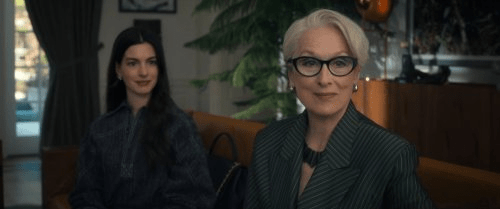
Even Miranda Priestly, the ice-cold fashion magnate who could alter a designer’s entire set with pursed lips or control her entire reality with a few choice and whispered words, must evolve with the times. That’s the lesson of The Devil Wears Prada 2, which comes and is set 20 years after its predecessor, but which seeks to put its characters through a very different series of lessons. Certain things do remain, of course, such as the expertly calibrated performance from the great Meryl Streep, slipping back into the role with elegant ease.
The 2006 film was primarily about Andrea “Andy” Sachs (Anne Hathaway), then a burgeoning journalistic talent who lucked her way into position of assistant to Miranda and learned rather quickly that she would need to toughen her view of the world to survive this new, ruthless one. It was perceptive and quite cutting in its observations about some of the innate qualities of the human personality, but it was also fresh and funny in a fantastical sort of way. The sequel attempts to reckon with the way of the actual, real world as it has regressed into one far less interested in relatively intangible concepts like fashion and journalism.
That’s simply not what the populace, especially the younger crowd, is engaging with anymore: It’s all about spreading virally across the internet, producing content—as one character deftly puts it—to consume while using the bathroom and navigating a corporate structure that’s always retrofitting itself for profits and the bottom line. Theoretically, it might be interesting to see Runway, the fictional magazine for which Miranda is still editor-in-chief after all these years, in a mode like this, but director David Frankel and screenwriter Aline Brosh McKenna (both returning from the last movie) are also quite interested in looking back with fondness and nostalgia.
Some of that is earned, because the first movie was exceptionally good at setting our expectations of its story and meeting them, largely thanks to the impeccably cast ensemble. In addition to Hathaway and Streep, we also get Stanley Tucci, as Miranda’s fashion director Nigel, and even Emily Blunt, as Miranda’s former first assistant Emily, now a senior executive at a luxury goods monolith. Nigel gets to impart his valuable wisdom with that old familiar mix of kindness and pragmatism, and Emily is still—if you’ll forgive the unspoken pun established two decades ago—a blunt object of ire directed right at her old professional rival.
The plot involves a coincidence of unbelievable proportions, as the simultaneous fortunes of Andy and Runway turn sour for entirely separate reasons. Andy’s just been fired, along with all her colleagues and by text, from yet another publication whose corporate parent decided to downsize its workforce. A major clothing line sold Runway a rosy version of itself, only to be undermined by the massive sweatshop it was concealing.
Our protagonist and the fashion empire which once employed her need each other again, in other words, for reasons that simply feel much slighter and more convenient this time around, despite the still-salient observations it makes about this industry. It’s less about these characters (although Andy does have a nice, frothy romantic subplot with property developer Peter, played well by Patrick Brammall) than some heavy wheeling-and-dealing that must take place with some new, basically ineffectual characters in the mix. There’s Jay Ravitz (B.J. Novak), opportunistic son of the previous Runway chairman who wants the restructuring, and a pair of elusive, recently divorced elites (played by Lucy Liu and Justin Theroux) who are unceremoniously shoved into the proceedings, purely as human plot devices.
We’re in a conflicted state, then, of fond reminiscence and rather tortured forward motion, the movie constantly reminding us of what we enjoyed about the original film in the first place but stumbling when it needs to do something with those new elements. The Devil Wears Prada 2 is still a mostly worthwhile experience, mainly thanks to its actors, but there are a few too many hangs-up along this trip down memory lane to ignore the cumulative impact of them.
Rating: **½ (out of ****)


Leave a Reply