Writer/director David Lowery’s Mother Mary is haunted by, well, something, and it’s both frustrating and admirable that the filmmaker is never quite able to communicate what that “something” is. It’s frustrating because the movie eventually boils it all down to a specific object, both figurative and literal in its meaning and functionality in the story. It’s admirable because Lowery has crafted a film just about as hypnotic as they come, on both a subjective and an aesthetic level.
This is not so much a story as it is a plot, and Lowery’s screenplay is not anchored in a plot so much as it is driven by a general vibe. That’s fireworks when the movie is really working, which for a long time is when the action is limited to the extended and revealing conversation between two old friends, colleagues or, maybe, something deeper than either of those descriptions or any others that might come to mind. One is a world-famous pop icon, preparing a comeback performance in the wake of a terrible stage accident.
All across the globe once loved Mother Mary (Anne Hathaway), but speculation ran rampant with the theory that the “accident” was really a suicide attempt. As played by Hathaway, our initial impression of Mary is certainly of a complicated and troubled woman trying to make herself small in a world that finds her larger than life. What she seeks is clarity of the professional and artistic variety, and perhaps unconsciously, she more immediately seeks an outfit that conveys an image both primally “her” and also, paradoxically, a rebirth or departure.
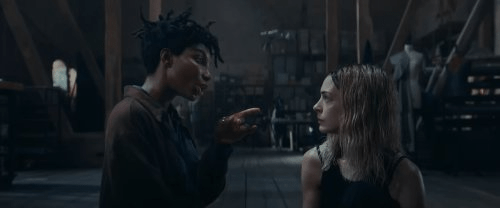
For this task, Mary hires Sam (Michaela Coel), the other major character in this story, who originally helped to design the style that came to define the character of Mother Mary. Now working out of a massive studio that resembles (and might once have been) a barn, Sam is wholly reluctant to help her old friend and creative collaborator. The first half, maybe a little more, of the movie is dedicated to the myriad of reasons for Sam to be cautious about the prospect of a renewed partnership.
Lowery has, thus far, been a filmmaker defined by bold filmmaking decisions, but this two-handed chamber piece is especially unexpected from him, and the performances from these two actresses are genuinely special. Hathaway’s casting as an inhumanly beautiful pop star makes sense, of course, but we also know that she can ably communicate this still-traumatized and strangely lonely woman’s insecurities with wholesale credibility. It’s simply an added benefit that we get some inspired scenes of Hathaway, as Mother Mary, performing the dark and atmospheric pop anthems (written and produced originally for the film by Charli XCX and Jack Antonoff).
Then, there’s Coel, whose Sam is still reeling from the personal and professional betrayal at the end of the original Mother Mary project, when the pop star shut her out of receiving any sort of credit for it, beyond the general compensation for her work. The actress is handed a lot of complexly written dialogue in the form of extended monologues, which technically operate as exposition about the history of this friendship and the different places in which each participant finds herself but are still deeply introspective, raw and revealing. It’s revelatory work from a performer who seems to be in the sweet spot of her breakout period.
Eventually, the movie must open up beyond its primary interior setting to focus on the actual reason for Mary’s rendezvous with Sam, which is preparation for the performance itself. That’s when Lowery, who shifts the story from being about the figurative ghosts that reside within a broken friendship to one about a maybe-literal-but-still-figurative ghost whom both women claim to have seen in the form of a floating red dress, rather overplays his hand. A few other characters (members of Mary’s support team played by Hunter Schafer, Kaia Gerber, Sian Clifford and Atheena Frizzell, a pop rival played by Alba Baptista, a possessed fan played by fellow song contributor FKA Twigs) arrive for a third act that comes close to spinning its wheels.
That’s certainly a shame in the context of how strong the movie’s set-up and extended conversation piece prove themselves to be. Whether Mother Mary ever proves itself to be About Something (and it’s arguable that the movie kind of doesn’t, even as a mood piece), those attributes, as well as the hypnotic spell it puts us under, make it quite a worthwhile experience.
Rating: *** (out of ****)


Leave a comment