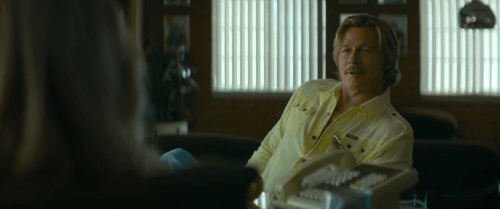
One might recall the character of Cliff Booth, especially as played by a charismatic Brad Pitt, in Quentin Tarantino’s Once Upon a Time … in Hollywood, the great filmmaker’s quixotic ode to the late 1960s in the entertainment capital of the world (as well as a sly bit of historical revisionism in its elaborate final act) as seen through the ideas of a famous TV actor and his stunt double. Cliff was the latter, and although Leonardo DiCaprio’s Rick Dalton does not make an appearance in this sequel/spin-off hybrid, Cliff assures us it’s for a good reason: Having gotten too fat for Cliff to double for him anymore, Rick moved to Australia for a new opportunity. As for the stuntman himself, well, he’s getting by on the many rumors and stories that have emerged out of his role in the events of the previous film’s finale.
This, though, is sort of a strange movie: The Further Mis-Adventures of Cliff Booth finds the man in a sort of stasis as a conference of events just sort of unfolds around him, several years after he violently ejected “some hippie weirdos” from his place of residence by way of killing them rather gruesomely, which is another way of saying that it’s surprising to discover that Cliff is kind of a bore. He was a rich character under the pen of Tarantino in 2019—sly and intelligent and mysterious in a way that was bolstered by some business in his past involving the high-profile death of his estranged wife. Here, he’s a celebrity who would rather not talk about any of the stuff he previously did, yet he still maintains a charisma—a type that now places him at a distance from us.
Pitt still fits into this role, of course, which is no surprise, given that the actor is one of the most charming and handsome in the industry. He also won a gold statuette for playing Cliff, and if that means Tarantino decided to figure out a reason to tell another story about him, we can’t really begrudge him that creative impulse. In a strange and ultimately ineffectual twist, though, Tarantino’s directing duties have been taken over by David Fincher—another filmmaker who has proven his great but, as it turns out from the evidence here, in the opposite direction from the original filmmaker.
Tarantino’s earlier film was defined by its looseness, its shapelessness (not a criticism) and its flat refusal to adhere to a plot structure, at least until a sense of mission and a need for some violence exploded in its third act. Fincher is all about control, precision and an even greater sense of mission and barreling forward momentum—all things that, because there really isn’t much to do with this character by his nature, this movie oddly lacks. It still looks great, as Donald Graham Burt’s production design recreates the era and Erik Messerschmidt’s crisp photography replaces the orange glow of the prior film with a darker palate to update Cliff’s seedy surroundings.
The plot does not quite hold to such scrutiny: Cliff is approached by Charlie Peters (Scott Caan), an old colleague on the same show that made Rick Dalton a name and now the new big thing (Tarantino himself interrupts a couple times to narrate some of Charlie’s highlights, which might have been put to cleverer use if they weren’t drenched in generative AI imagery), to put his skills of witness protection to good use. The contact is made by way of Charlie’s talent agent, the pretty (and very tall) Karen Crosby (Elizabeth Debicki, who is very tall), and a romance develops between her and Cliff on account of them both being rather attractive (and, in her case, quite tall). The threat is something to do with a possible hit on Charlie’s wife Toni (Carla Gugino), who also has a past with Cliff (because of course, she does), and a pair of vengeful Filipino brothers/assassins (played by Matt Groove and JB Tadena).
To be more specific than that would be, of course, to enter into spoiler territory, but basically, it all leads to a climactic shootout and fistfight that feels like an entirely separate movie than the one we had been watching until that point. There are elements here of a more understated character study, like some hangout-movie material between Cliff and his father Gus (Peter Weller, welcome but wholly underutilized), and the movie introduces an intriguing character played by Yahya Abdul-Mateen II, only to sideline him for the purposes of furthering the plot. All these ideas feel somehow disconnected and disorganized, as if Tarantino and Fincher separately half-realized them before, perhaps, needing to go into production to suit the suits.
There are ideas, as in a scene where Karen (played so well by Debicki that you’d think this was her movie—and come away hoping it was, considering how it treats the character) explains her philosophy as a one-time movie critic, but they are entirely removed from the rather humdrum routine of the plot of The Further Mis-Adventures of Cliff Booth. Here is a spin-off with some promise that plugs in many of the least useful ideas about how to realize them.
Rating: ** (out of ****)


Leave a Reply