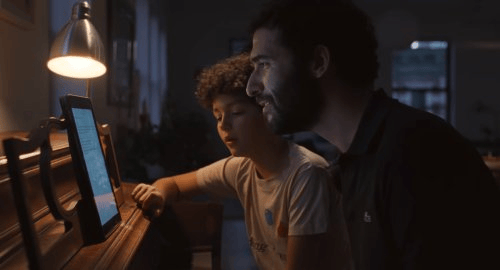
Generally speaking, we have met characters like the (arguably eponymous) one in Club Kid: a pretty directionless guy who needs to get his act together but only recognizes that and makes strides toward doing so when the real world arrives, unannounced, on his doorstep. That means writer/director Jordan Firstman’s debut feature isn’t anything especially new within the annals of coming-of-age dramas, even though the character here is technically a grown man. The specificity and detailed nature of this particular story, though, do make it feel fresh in a lot of important ways.
The first is absolutely the milieu that serves as the backdrop here, which is a New York City as defined by the underground raves and the parties and the drug scene so enjoyed by the likes of the protagonist and his many friends. Firstman also stars as Peter, who begins the story in the year 2016, as a hard-partying gay man bouncing between these raves and clubs—in the latter capacity as a DJ and club promoter. Peter loves drugs, solely as a recreational habit and a way to stave off the drudgery of a typical existence, alongside his best friend Sophie (Cara Delevingne) and a motley crew of queer friends whose shared interest makes them all inseparable.
This is often a very funny movie, by the way, with no precociousness about its influences (a movie directed by one of them literally plays on a television at one point) or impulse toward shyness about its adult/sexual content, which becomes an even funnier, always present joke as the story moves forward. As funny as it often is, though, the film is also quite touching in some spots that surprise us. Peter has lost his mom, for instance, and while he makes it clear that the relationship was a complicated one (a lot of unspoken truths reside in a perfectly executed pause in one moment, suggesting that we know exactly what the complication was), yes, he misses her dearly and often.
The film’s prologue captures Peter as a significantly younger man with significantly fewer worries, as he receives the flirtations of a woman with kindness and an explanation of his own predilection. The encounter leads to more drinking and snorting, and ten years later, it’s a miracle that he’s able to recall anything about that night, let alone enough to be basically aware of who was around him and what he did. The long and short of it is that the experience led to a son, Arlo (Reggie Absolom), and because that clubgoing woman from so long ago had a pretty horrible life in the interim, her premature death—and the lack of anyone else to do anything for him, as an old mutual friend (played by Kirby Howell-Baptiste) explains—means that Peter is now and must suddenly become a father with responsibilities.
Again, this not exactly a new or particularly original story within the broad outline of what happens here, which is that Peter cannot entirely change everything about his living space (filled with shirts that are appropriate to the right people, none of whom are 10-year-old children) or the way he lives (filled with stories from his friends, who are all those “right people” mentioned in the previous parenthetical) to accommodate a kid right here or right now. That he must leads to a lot of that comedy, occasionally of the cringe or discomforting variety, as Arlo learns to become a DJ, on account of a deep and abiding love for the music of his late mother’s generation, and to converse in the profane manner of his new dad and his many friends (one of them, played by Saturn Risin9, is impressed and amused by the kid’s talent).
The conflict of the story comes in as Peter and Sophie’s friendship begins to break down, right alongside their professional priorities, and the latter spirals heavily into more and more drug use—of the dependent variety this time, which only makes her paranoid and unstable and a bad influence on both Peter and Arlo. The last act of the screenplay catches up to its characters in a way that adds a layer of melodrama atop everything else, although the performances manage to ground everything in some form of sincerity. One might not be expecting the trajectory of this movie to include a trip to England, but it offers Firstman, as Peter, the opportunity to deliver a Big Speech that the movie earns.
In a subplot that contributes to the more modestly predictable nature of the storytelling, Peter also meets Oscar (Diego Calva), who is Arlo’s social worker but becomes much more than a tangential connection in Peter’s life when they decide to explore a mutual attraction. It’s not much, but at least the movie avoids any unnecessary complications. Another subplot follows Peter’s younger roommate (played by Eldar Isgandarov) and much older neighbor (played by Colleen Camp) through a series of purely comic events that build toward multiple, successful punch lines.
It’s also appreciated that the movie finds its way toward an ending that is happy—with a few compromises and nothing truly tidy or easy for its characters. Club Kid makes it easy to like these characters, too, because they are all heavily flawed and fully understandable for those foibles.
Rating: *** (out of ****)


Leave a Reply