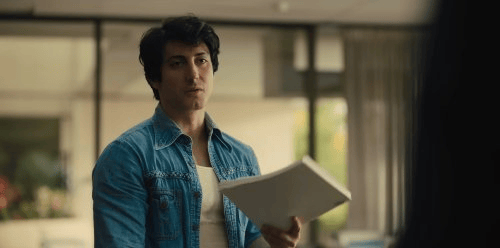
Rocky, released in 1976, is one of the cinema’s great underdog stories, as it follows a working-class boxer and loan-shark collector as he trains to fight a heavyweight champion and, by the end, instructs the audience on how to react to a slightly different sort of “happy ending” (a subtle act of subversion that’s easy to forget until the next time one watches the movie). I Play Rocky takes the making of the film, from the point-of-view of its writer and star, and turns it into an underdog story, as well, with a working-class actor, struggling to make a name for himself, who writes a screenplay that sends shockwaves through the industry. In case it isn’t clear, these are very different types of underdog story.
There is something broadly inspirational about the making of Rocky, as anyone unfamiliar with those circumstances will learn over the course of screenwriter Peter Gamble and director Peter Farrelly’s film, but it’s a fascinating process of realizing that the stakes hang upon something entirely separate than what the filmmakers seem to believe about it. Everything in Hollywood is a game of trying to pitch to the right producers, after all, and every bit of this side of the story just sort of happens by accident to Sylvester Stallone (Anthony Ippolito). Yes, the first half of the film here is strong, as Sylvester—who has called himself “Mike” for as long as he can remember—hustles to make something of himself and winds up writing Rocky in just a few days and on little sleep.
A lot of this falls on the shoulders of Ippolito, a relative newcomer or, at least, an actor whose star is almost certainly about to shoot into the stratosphere when the awards season has its way with him. The performance is not solely in the uncanny way he captures the physicality and the idiosyncratic voice (the result of a pinched nerve on the left side of his face and neck) but also in how he captures the steadfast determination not to allow his upbringing (being raised by a stern and verbally—and otherwise—abusive father, played by Matt Dillon, and an adulthood occasionally spent in search of work and housing) to determine his life path. It’s categorically great work in all senses of the term.
One subtle achievement here is the fact that, though we already find it easy to like Stallone in real life, the film makes us like him on its own terms and as a character in a story being brought to the big screen. He auditions (or tries to audition) for anything he possibly can, to include the burgeoning adult-film business, and meets Sasha (AnnaSophia Robb), a pretty and opinionated theater worker who is box office attendant while he tears tickets, who becomes his devoted and supportive wife. Upon her suggestion, he starts writing screenplays for himself, none of which hit until the story of the journeyman southpaw.
From here, the movie becomes a very different one—less about the hustle to get it made, even as the majority of the plot is taken up with that process, than it is about the politicking to get it released. Sylvester’s part in it becomes slightly less important than his meeting a pair of major film producers, Irwin Winkler (P.J. Byrne) and Robert Chartoff (Toby Kebbell), and becoming a point of contention between them and United Artists when he insists upon starring in it himself. Tracy Letts is very funny as a composite of various UA executives, haunted by and resentful of a major, award-winning mafia picture from a rival studio—one which they, in an alternate universe, could have had.
This means a number of opportunities for the actors to recreate various scenes from the earlier movie, while telling us how a few of them came about (Stephan James and Kiki Seto play Carl Weathers and Talia Shire, respectively—each of whom gets the job while lying about their qualifications to do certain sport or related activities). The crew is also under the wire on behalf of a studio contract that requires absolutely no wiggle room in the shoot schedule (Jay Duplass plays the director, John G. Avildsen, as a guy who might at any moment crack under pressure). It’s broadly amusing and quite funny at times, but there is a constant feeling like the film sort of loses the plot and its focus upon Sylvester as the creative force behind it.
After all, once the shift occurs to the actual making-of, the stakes and conflict of the story also shift, from a broadly inspiring one about hard work and an unlikely, once-in-a-blue-moon chance for a man who never thought he’d have this opportunity to one in which the actually inspiring part here lay in the fine print of a studio contract that creates an environment of failure and, almost accidentally, the path to success. We know how this will all go down, too, which makes I Play Rocky—in spite of its tremendous lead actor—a foundationally predictable and slightly patronizing crowd-pleaser.
Rating: **½ (out of ****)


Leave a Reply