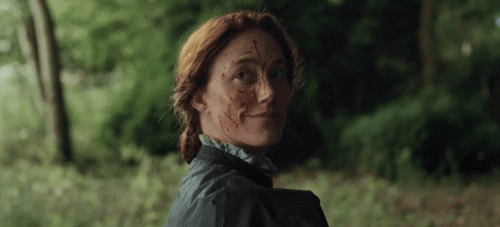
It’s clear that director Zachary Wigon wants Victorian Psycho to be the type of devious and twisted entertainment that its title—taken from Virginia Feito’s 2025 novel, of course, but evocative of a certain movie that came out at the turn of the century—suggests, but despite the handsome production, the satirical (almost parodic) twist on the material, and a singularly committed lead performance, the movie remains only intriguing as such on the surface level. The film has a lot of style and focuses all its attention upon the maintenance of that style, but it does little else with it. The result is a half-hearted shrug of a movie that tries so hard it circles back around to an exertion of half the effort.
That is, once again, despite the performance from Maika Monroe as Winifred Notty, a budding governess who wishes to take a position at a house of renown and good repute—that of the Pounds family, who own a Gothic estate somewhere in mid-19th century England. Winifred is an oddball right out the gate, as the film’s introduction to her has the young woman’s head cocked to the left and a vacant stare that almost certainly does not fill in with anything of note upon righting herself and arriving at the doorstep of the estate. There is something almost dithering about the blank look upon her face—and then Winifred begins to speak.
Things just sort of spill out of this character’s mouth, and one—everyone in her vicinity or who has ever met her, for instance—gets the impression that the concept of a social filter has never been introduced to Winifred. This is partly because it’s simply the character’s personality and presentation, which Monroe is clearly having a blast with bringing to life. It’s also to do with the ironic remove of Wigon’s approach, which is intriguing on its face and rather shallow when we understand what the movie is trying to say and to do with this character.
She must have arrived at the Pounds estate—called Ensor House—for a reason, after all, and she’s not exactly tight-lipped about that reason, confiding in the family nurse Ms. Lamb (Thomasin McKenzie) that she sees for herself a future within the ranks of the very family with whom she has been placed as governess. They include Mr. and Mrs. Pounds (Jason Isaacs and Ruth Wilson) and their children, the oddly quiet Drusilla (Evie Templeton) and the pompous Andrew (Jacobi Jupe), all of whom initially look upon Winifred with suspicion and snobbery. She, who does not seem to operate by any usual facet of the human personality, is a lot less easy to read.
That she means business about taking her place among the Poundses, for instance, eventually comes across as a random sort of aggressive obsession, because this character’s obvious psychopathy is more of a plot device than anything Wigon or Feito (adapting her own novel) is willing or interested in exploring here. The film becomes a turnstile of staff members vanishing around the family with no explanation, though, of course, we see everything in sometimes gory detail, as Winifred meets resistance from the family and lashes out in idiosyncratically violent fashion. The first victim is the gardener of the estate, and then the various secrets and attitudes and confessions and general ribaldry come spilling out of the movie’s every orifice, as we learn the specific reason for Winifred to have targeted this family and this estate.
That reason is a superficially shocking one, but again, it’s mostly just a device to get us to the bit of third-act bloodletting—intriguingly framed as a bit of reality-warping fantasy inside Winifred’s head but, because it’s here to give us what we want as bloodily as possible, only framed as such and with nothing to give us a reason to care about the characters or their fates. Wigon shows some skill at stylizing everything to the hilt, sometimes mounting the camera on objects (like, in a few instances, the weapons—such as axes or the bayonet of a rifle—which Winifred wields) or, with the help of cinematographer Nico Aguilar, tilting our view of the action to reflect the tilted view of this absurd and satirized world, made of money and secrets and proper poise.
Monroe’s performance gets us closer to embracing all of this, and the supporting cast—especially young Jupe and Templeton—are finely tuned, as well. Victorian Psycho, as a whole, though, falls short of providing anything more distinct than a broadly macabre attitude that exists mostly for itself.
Rating: ** (out of ****)


Leave a Reply