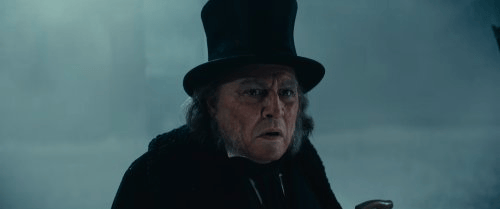
Charles Dickens’s 1843 novella A Christmas Carol (originally titled, of course, A Christmas Carol. In Prose. Being a Ghost Story of Christmas), in which a miser is haunted into being generous, is a lot of things, and the operating idea behind Ebenezer, directed by Ti West and adapted by screenwriter Nathaniel Halpern, is that one of those things is a ghost story. After all, the word “ghost” is in that original title, and the word “haunted” can be plugged into any basic synopsis of the story. It makes sense, then, for a filmmaker to take advantage of that angle—and, indeed, is quite surprising that no one, until now, has in any sense beyond the naturally creepy third act and visit from a Christmas spirit.
West, of course, is a filmmaker with a studied history of the genre, which makes his mixed attempt here all the more underwhelming. It’s in the period details of the thing, from Eve Stewart’s mid-1800s production design of a Gothic London, to Checco Varese’s appropriately grim cinematography that cloaks everything in glumness to match the protagonist’s attitude, to Tyler Bates’ organ-heavy music score, which jangles and thrums to the vibes of its director’s chosen aesthetic. The film is a handsome production, in other words, although that only gets it so far.
Eventually, the many, many themes—both on the surface and buried beneath it—of Dickens’s text must find their way to the top, and while they eventually do so, West’s focus upon the outward elements of his production, as well as his lead actor’s ability to create another of his cinematic misfits, becomes garbled and mixed. Do we really need, for instance, a Ghost of Christmas Past that actually seems to arrive from the same realm as her Yet to Come counterpart—draped in white, sickly as a skeleton, with cataracts layered over her unblinking eyes? At least the one from the future befits its mission, which is simply to point the way forward for Ebenezer Scrooge to see the fruits of his miserable existence.
Still, something feels off here, and it starts with Johnny Depp, who might at some point in his career have been an interesting candidate for Bob Cratchit, the hard-working and hard-won employee of Scrooge’s who cannot even have the holiday to spent with his wife and children (one of them stricken by a “deficiency,” as Scrooge puts it). The days of a softer Depp are, sadly, long gone by now, and so, the actor takes on the eponymous role with a wobbly mixture of occasional sincerity and, otherwise, overwhelming quirk. Yes, Ebenezer is rude and crude and hunched after years of snubbing and snobbery, but Depp turns it into a caricature until it’s too late to give him much credit for chipping away at the surface to find the tragedy underneath.
Oddly, the casting of Bob is much more appropriate here, given that Rupert Grint spent the formative years of his career playing the son of a similarly defined man in a certain fantasy series. The actor is wholly credible and convincing as a father who wants to have given much, much more to his family than he has, while his wife Emily (Charlie Murphy) assures him that she knows he’s given what he can. The same goes for Sam Claflin, as Scrooge’s nephew Fred, who never knew his mother and, though exasperated by his uncle, realizes that Scrooge means much more to him than anyone—including his wife Clara (Daisy Ridley)—can understand.
Obviously, the story remains the same, as Scrooge is first haunted by the spirit of his partner in business, Jacob Marley (Ian McKellen), who forewarns him of three spirits—of Christmas Past (Andrea Riseborough), Present (Tramell Tillman) and future (the form of Robert Strange)—whose efforts might make him a more useful contribution to society. Thus follow the three visits, divided as the novella was into “staves,” and the first disappointing thing is how dutiful these feel in delivering the original work’s message and, at the same time, rushing through them to get to the end. Riseborough adopts a reedy, whispery voice and a wry sense of humor for her part, and the conclusion of the movie at least offers something different for Depp to deliver in the form of a changed world view and a brighter perspective.
The best stretch here belongs to Tillman, who commands the screen as the second spirit—introduced as a glutton and, most suggestively, slowly cracking and crumbling as his visit deprives him of sustenance, and the appearance of the two emaciated children, for what it’s worth, is a grotesque visual detail that works because it’s so disturbing and so unexpected in its execution. Too much of Dickens’s work, though, has been condensed philosophically for Ebenezer to come across as more than effective in the most basic elements of this immortal story—one that manages to be about everything under the sun when it comes to its grumpy protagonist, while this adaptation only pays lip service to all the rest of him.
Rating: **½ (out of ****)


Leave a Reply