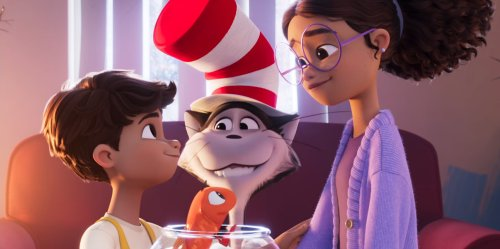
Given the breadth of books written by Dr. Seuss (more than 60 over the course of 40 years, in case one never really put that into perspective), it is interesting that only a few have received movie adaptations, and here, for the second time, is a feature-length animated effort arriving a couple of decades after a live action version that featured a comedic actor in layers of makeup prosthetics. We can be thankful, at least, that The Cat in the Hat moves in the opposite direction of its predecessor from that other, Christmas-themed property, although that’s only giving what writers/directors Erica Rivinoja and Alessandro Carloni offer here the small bit of credit it actually earns. The movie at least isn’t a garish monstrosity, but it is pretty disposable, which is its own brand of unforgivable.
The appeal of the Seuss texts was always in how simple they were in theme and in message, despite how overly complicated and elaborate the illustrations embellishing the story actually were. The screenwriters, for instance, do follow the basic outline of the 1957 book of the same name, in which the Cat in the Hat—a personified id representing the deep desire to find joy in the absurd once again—appears to a couple of lonely children, attempts to brighten their day and fixes the mess he causes before mom arrives back home. When the movie does pay attention to the message that arises from this—including a minor revelation about some business in the Cat’s past—it can be quite lovely.
The problem, as before, is that this movie cannot leave well enough alone when it comes to the eponymous, anthropomorphized feline himself, voiced here by Bill Hader in a way that establishes a single, droning personality for the Cat and never does anything else with it. While it’s true that the Cat of the book wasn’t a particularly deep character beyond what he stood for in the presence of the children in the story, this one makes him a central figure in a few too many ways by touring a behind-the-scenes world where Seussian characters can intermingle and do work inside a corporate conglomerate that measures the happiness of children. The Cat is particularly skilled at doing this, but the story here finds him in trouble for that.
Broadly speaking, the company in question, whose president is voiced by Giancarlo Esposito (the joke of the character is that he’s a dimensionless bore—in that he’s all front with no profile from the side and, therefore, no depth), measures an employee’s performance using two metrics. The first is the literal expression on the child’s face upon the conclusion of the encounter, using a type of rolodex with every conceivable expression of the human personality. The second is how much of a mess was made in the process—the higher the number, the worse the mess and its reflection upon the employee.
Maybe this is a little bit of a satirical ribbing of a corporatist mindset, although the entire system doesn’t really make any sense, and the filmmakers don’t try to clarify anything or address the questions it raises before attributing one of the two methods to being a “bad” metric. Anyway, the Cat is given a second chance to prove himself by handling a particularly troublesome situation in which to inject some joy, and that’s, well, the origin story of the reason the Cat finds himself in the presence of the two lonely children in the first place. This whole “demand for an origin story” thing really is a distraction and a gimmick, isn’t it.
The family consists of a single mother, Carmen (voice of America Ferrera), and her two children, Gabby (voice of Xochitl Gomez) and Sebastian (voice of Tiago Martinez), who have just moved into an apartment after downsizing from a house for unspoken reasons (Paula Pell voices the poisonously cheery landlady, who immediately threatens eviction if the rules are broken). The Cat arrives while Mom is at work, and the adventures begin, as he promises a time-travel remedy but immediately loses the tool to make it possible. The amusing set-up of the adventure here is that they (alongside a now-talking goldfish, voiced by Matt Berry, and with the occasional aid of his mischievous, nonverbal Things, for which the Cat directly promises a spin-off in one line of dialogue) must journey inside a trio of cardboard boxes, which house fantastical worlds free of gravity or logic, to retrieve the doohickey that does the whatever.
For a while, it’s just a tour of these worlds, which are actually vessels for lost memories of the family’s landmark moments, but while there’s a bit of potential in the idea of discovering dimensions to their mother (now a workaholic surrounded by white paper) that they never imagined, the film only decides to explore that potential in the midst of a chaotic climax where the heroes are also trying to fend off a dragon-like creature that mostly stands in for itself. The Cat in the Hat is, one supposes, harmless, but it settles for the obvious route of adventure time, which overwhelms the simplicity of the tale and the sparks of humanity trying to break through.
Rating: ** (out of ****)


Leave a Reply