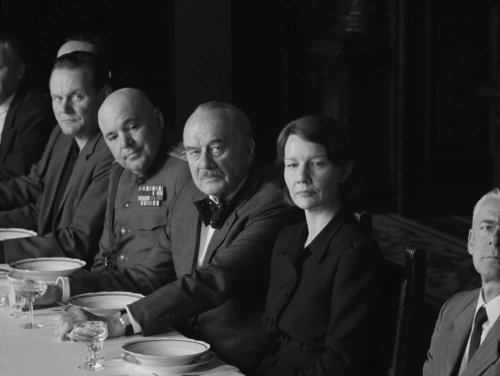
Four years after the collapse of the final Nazi strongholds and the death of Adolf Hitler, the celebrated author Thomas Mann and his daughter Erika have been invited so the former can be gifted an award in Frankfurt, Germany, to join the Nobel Prize he received two decades earlier. Just as he learns he is to be honored in Weimar, he also learns that any potential return to the United States would mean a targeted investigation by a certain Wisconsin senator who, in 1949, is conducting interviews about alleged communist activity. That is the set-up for what becomes a very different and infinitely more internalized story in Fatherland, the new film from Paweł Pawlikowski.
Here, the screenplay is more concerned with the Mann family itself as they tour the effects of the authoritarian regime from which they have emerged as two of the “good Germans.” The director, alongside co-screenwriter Hendrik Handloegten, uses this opportunity to explore that via a series of conversations and encounters in which it is made quite plain that Thomas (Hanns Zischler) and especially Erika (Sandra Hüller) are uneasy and increasingly infuriated by the connection that might be made to the Nazi movement by way of the father’s fame. That’s apparent in a pair of early exchanges that are notable for the way they employ expository dialogue.
One of them is between Thomas and a pair of much younger men (played by real-life brothers Enno and Theo Trebs), who happen to be the grandsons of Richard Wagner. He, of course, was the undeniably great composer whose influence upon Hitler has already become a point of controversy here—not least because these younger Wagners wish for Thomas to help them in rehabilitating a certain music festival that was a favorite hot spot and cultural landmark of the Führer. Thomas is quite terse with his response to this idea, which is sensible given that he himself has been receiving letters—intercepted by his daughter—that call him a traitor to his homeland.
The other exchange is between Erika and her ex-husband, the infamous actor and theatre director Gustaf Gründgens (Joachim Meyerhoff), whose early career highlights working with Fritz Lang and Max Ophüls was obviously overshadowed by his later apologism for the Nazi party. That exchange ends with a punctual smack right across the face. It’s reflected later, too, when a rowdy group of men sing a song whose lyrics are now irrevocably tied to the far-right authoritarianism of this country’s recent past.
The entire film is made up of small but potent moments like these, anchored by a pair of performances from Zischler and Hüller that chip away at an austere exterior to find the anguish underneath. The plot, such as it is, begins with some sad news: Klaus, Thomas’ son and Erika’s brother, has committed suicide, by swallowing a bottle of sleeping pills, at a hotel in Cannes, and now, arrangements must be made for his funeral and for the future of this family. August Diehl plays Klaus in a few, memorable appearances that, at one point for Thomas (and likely for Erika, too), literally haunt the proceedings like a bad dream.
Arriving in Weimar, the father prepares a speech to accept his award, meeting a pair of high-ranking German officials (Devid Striesow as Johannes Becher, a fellow writer and devoted communist, and Daniel Wagner as Sergei Tiulpanov, director of the propaganda wing of the Soviet Military Administration in Germany) and learning that the detention of political prisoners at Buchenwald may not have entirely ended yet. The film is resolutely against any idea of rosy, tidy or white-washed history, and so there is no actual resolution here. Indeed, if it feels like a tour of sorts, the respectful quiet of Pawlikowski’s treatment of this material almost takes on the quality of a whispered walk through a museum.
The spareness of the production, which recreates the period but does so through relatively unshowy means, reflects that, too, with its aesthetic focus limited to a series of interior shots and an eye for Spartan furnishings and simple shot set-ups. Cinematographer Łukasz Żal, once again working with Pawlikowski as part of their longtime collaboration, shoots everything in black-and-white, but neither of these men is attempting to reinvent or revolutionize the form here. The use of shadow is oppressive, and every shot, more or less, is meant to convey some kind of stillness and symmetry.
It’s not until the final ten minutes or so, as father and daughter find a moment to grieve a son and brother, that Fatherland finally recognizes that significant emotion drives its human subjects. Thomas and Erika simply sit, listening to the music, weeping for what was, what might be, and what can never be again.
Rating: *** (out of ****)


Leave a Reply