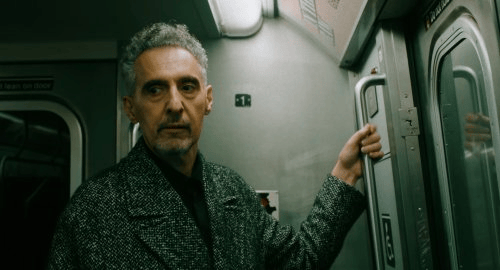
Harold “Harry” Lehman (John Turturro), the protagonist of The Only Living Pickpocket in New York, lives in an analog world—or, at least, that’s how he sees himself and, by some measure, how he prefers it. As the title suggests, Harry makes a living by flogging the wares of other people, selling off stolen merchandise for a hopefully hefty sum and receiving cash in return. It’s a different world now, though, with watches that do much more than tell time, cell phones that do much more than connect calls, and money that can be stored in a digital wallet protected by a personal identification number.
Harry was once hunted by police, but he now enjoys suggestive conversations with the detective (played by Giancarlo Esposito) in charge of his case, who is about to retire and not valued enough to care anymore about the small-timers. He takes care of his wife (played by Karina Arroyave), who is now near-catatonic from an unspoken disability, with the money he makes from his efforts. There might have been a time when he needed to conceal his activities from the pawn shop proprietor (played by Steve Buscemi), but the man probably figured it out decades ago, given the obvious depth of their friendship.
This is where writer/director Noah Segan’s film finds Harry, played by Turturro with world-weariness and an at-first cool sense of confidence, which eventually turns toward desperation and a less immediately recognizable acceptance of this brave new reality he inhabits. The movie is as much a ticking-clock thriller, once an antagonist emerges to give an ultimatum with some power behind it, as it is a sturdy character study. In some ways, it works better in the latter mode than the former, which must, simply by its nature, operate with a bit more familiarity.
It doesn’t even matter, though, that the film seems to be circling a drain, because the dynamic between this “hero” (though he is slightly compromised on any moral high ground, at least he seems to target the rich, as a brief prologue with John Gallagher Jr. as a mark informs us) and his “villain” (who is, thankfully, pretty straightforward in his antagonistic role here, with nothing to suggest the possibility of redemption) is so fascinating. If Harry lives in an analog world that has turned digital around him and left him behind, obviously that means the bad guy here is a part of that digital world. Indeed, Dylan (Will Price) is a massive prick, comfortable in his excesses and confident in his ability to wheedle the information he needs out of anyone, using any means.
Their paths cross one night when Harry, by now addicted to the process, notices a restored muscle car in a parking lot and, just as he’s about to pilfer it, is interrupted by Dylan. Harry still manages to make away with a gym bag, in which he’s not surprised to find the kid’s wallet, an ornate watch and some running shoes. He’s far more surprised to find a loaded gun, and so he dumps it and takes the rest—including a currency locker, which of course he does not recognize for what it is, having only recently found out about the different generations and sizes of iPods.
For his sins, he never suspects that Dylan, through his confidence (which is rightly placed—a breath of fresh air for a movie bad-guy), is quite gifted at tracking someone down using almost no initial information. Within the span of a few hours, during which Harry successfully fences the USB card to another shop owner (played by Kelvin Han Yee), Dylan has found and prepared to threaten Harry’s wife, giving him until four o’clock on this most eventful day to return the card. That leaves Harry to his devices, his creativity, and his acts of desperation to turn his own fortunes around.
If this all sounds relatively familiar, that’s actually to the film’s credit, especially in the ways Segan labors to avoid showing us any of the violence in the wings of this low-key thriller (Sam Levy’s crisp cinematography and Gary Lionelli’s jazzy score do the work to sell us on this slightly anachronistic view of postmodern New York). We find Harry’s wiles absorbing to watch as he makes a series of fateful moves near the end of this journey, which includes a visit to the daughter (played by Tatiana Maslany in a single, wrenching scene) on whom he effectively gave up years ago, who clarifies what sins are too late for the healing. Then, there is genuine pleasure to be found by the final, affecting montage, as we realize the film and its protagonist have been smarter than even we might have anticipated (it involves a cameo in which an uncredited actor receives the chance to play against type in a surprisingly effective way).
Really, it all comes down to Turturro, even with the strong supporting cast that surrounds him. If we can’t believe this character, the familiarity of The Only Living Pickpocket in New York might have overtaken what works here, but Harry and Turturro ensure that that doesn’t happen.


Leave a Reply