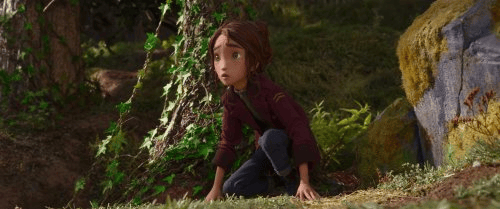
The art of stop-motion animation, which involves the meticulous and incremental movements of every aspect of puppet or clay figures, can often either be taken for granted—perhaps because we settle into a place of comfort within the story and put off other considerations—or call attention to itself—especially true in the handful of cases when the form itself actually does overtake other considerations. Wildwood, which also represents a leap forward in form, presents something of a paradox: It’s a little bit closer to an example of that latter trend, in which the animation style rather leaves its story behind in some respects, yet it does also tell a story that is often moving and, by the end, genuinely surprising. It’s simply that no tale could possibly match what we see on display here.
Take the opening sequence, in which the tragedy of the film’s eventual antagonist unfolds with dreadful inevitability. A mother, known and referred to as the Dowager Governess but named Alexandra (voice of Carey Mulligan), is forced to watch as her son climbs onto the railing of a balcony and leaps to his death, even as she screams and lunges to intervene. It’s a startling sequence, but it also introduces us to an initially inscrutable visual concept, which is that the boy reaches into his own chest and pulls out a mechanical cog where his heart should be.
That action begs a lot of questions, of course, but we begin to get the idea almost immediately as the Governess crouches over her robot son’s body before being hauled away by suspicious officials in uniform. This is how screenwriter Chris Butler and director Travis Knight introduce us to this story, which comes from a children’s book written by Colin Meloy and illustrated by Carson Ellis, and it offers something of an education about just how to open a movie without revealing too much about where things are headed. We pick up sometime later in a suburb of Portland, where a family of four live comfortably but abide by one simple and strict rule.
The younger child in the family, an adorable toddler named Mac (voice of Arthur Knight—the director’s own younger son), must always stay in the house, say his parents (voiced by Maya Erskine and Jake Johnson), but of course, any older sibling around the pre-teen/early-teen age of Mac’s sister Prue (voice of Peyton Elizabeth Lee) is going to stretch or even break any rule that he or she does not understand. That winds up being Prue and Mac’s undoing, as a simple trip to a local park ends in the nightmarish kidnap of Mac by a murder of crows that all seem to be strangely in-sync in their actions. As they escape into the forest, Prue also makes the mistake of ignoring her parents’ other rule: never to go into that forest.
In other words, this is the stuff of a classic fantasy-adventure tale, because of course Prue will go into that forest. Of course the wood will reveal itself to house sights and sounds that are as fantastical as they are still rooted in the rules of reality and the realities of planet Earth. Animals speak and farm the land and plot and rally forces, to be sure, but they’re joined by a group of human bandits (Mahershala Ali voices their fearless leader), a tribe of ancient mystics (led by Tantoo Cardinal as the eldest and wisest of them), and, eventually, Prue and her nebbish young friend Curtis (voice of Jacob Tremblay), who just happens to be with Prue when Mac is kidnapped and the action begins.
What follows relies upon two key pieces of exposition, one of which fully explains the backstory that led to the startling opening sequence and the other which almost completely rewrites how we might interpret the meaning of the message behind the story. We can be pretty open about the former, which is that Alexandra’s son died in a freak accident and she sought to replace him. Hints of that rationalization seep into the second point, which otherwise contains a truly jarring twist that, obviously, should not be discussed in a review.
If there is any caveat here, it’s that the complications that arise do not immediately suggest such an obvious way of bringing them into a climactic battle sequence, which is almost always too simple a resolution for anything. Then again, even the bigness of that sequence is boiled down to a simpler confrontation that, because of what we know by then, takes on a greater degree of significance for everyone involved. If the plot has become a bit too busy with the number of other characters who are introduced (Angela Bassett as an eagle general who becomes a guide of sorts, Awkwafina as a helpful rat who becomes a bona fide hero, Charlie Day and Tom Waits as coyotes on opposite sides of the conflict, and more), this sort of narrowed focus feels just right for what Knight’s trying to do.
Plot mechanics aside, the real story of the movie is its aesthetic and animation style, which stun with every pan of the camera, every cut to a new and exciting location, and every one of those new characters upon their introduction. It isn’t just the design of the characters and sets, either, but also the supporting visual effects that help to build out their world. That final confrontation, for instance, is as much about what is happening as about how, such as the manipulation of a great clump of ivy with importance to the mythology behind the story.
Before that, too, is that great climactic battle, in which Knight is not deterred by the potential of a family-friendly audience when soldiers and farmers alike are mowed down by bullets and arrows, blown up by fireballs launched from trebuchets, and otherwise treated as the participants of any given battle sequence in a fantasy adventure. Wildwood is a story about its spectacle, and that spectacle is something to behold.
Rating: ***½ (out of ****)


Leave a Reply