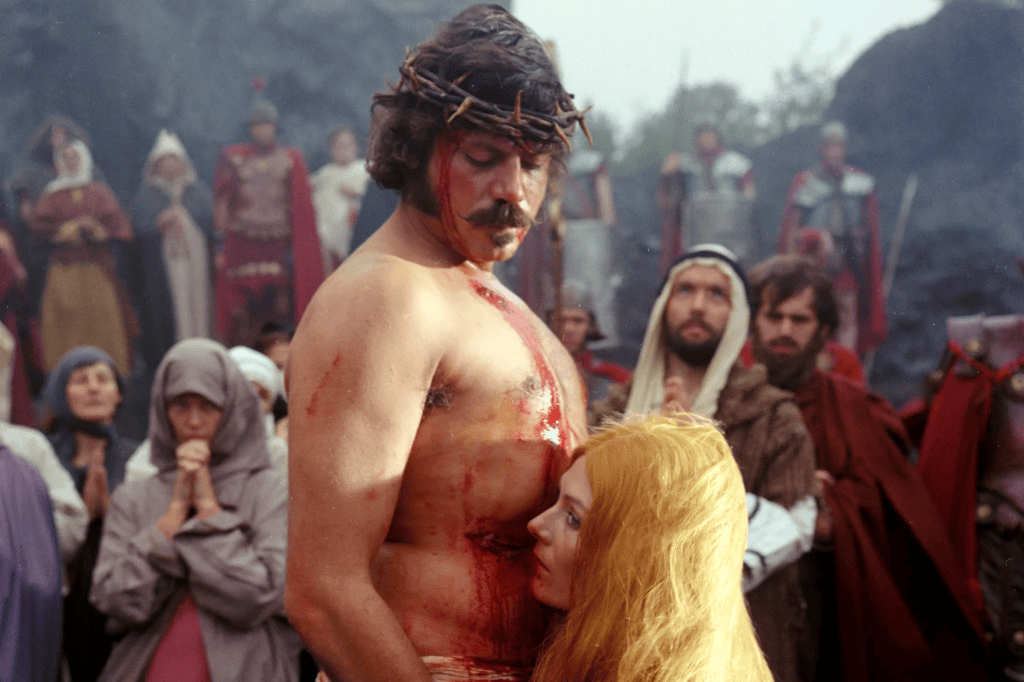
It is impossible to review The Devils in 2026 without acknowledging the censorship history of Ken Russell’s admittedly shocking but exceptionally thoughtful film (an adaptation of both an Aldous Huxley novel and the stage production by John Whiting). Made in 1970 under the purview of—let’s just say—a very different Warner Bros. Pictures than what we have today, the final result was deemed so objectionable that it underwent major and transformative cuts, with the original print disappearing in the vaults of the studio until they were re-discovered in November 2002. It’s important to talk about these events, not because they are necessarily relevant to the film’s quality, but because the sequence that was removed is possibly the most important—and, by a significant degree even for what this movie has in store, most sacrilegious—of the whole affair.
Another part of this miraculous re-release that is important to point out is that it has received a rating of NC-17 by the Motion Picture Association—a fact that is also inexorably tied to the sequence that was cut. Indeed, it’s quite understandable, once we see it, why the film has been given this rating (aside, of course, from the general uselessness of the MPA as an institution). On the face of it and taken within the context of a limited perspective, the sequence is thoroughly objectionable—an orgy of profound lasciviousness, for which “where” and “upon what” and “involving whom” are all such openly blasphemous conjunctions and pronouns when applied to this situation that it’s no wonder objections were had.
This is also where it should be noted that the outrage, while fully understandable, is also quite silly and, really, offensive to what Russell is going for here, and indeed, it’s a shame to consider that, until now, audiences in the States were given a version without the scene and, thus, came away with an incomplete vision of the film’s entire message and even an unfinished layout of its basic plot. The orgy, after all, is where the film’s antagonistic characters—the zealous hypocrites at the top of the religious pecking order in 1634 France—are duped by a sadomasochistic “witch-hunter” into reversing, rather subtly, their own attitudes toward the allegedly demon-possessed nuns who have fallen under a “witch’s” curse. The frenzy that occurs as a result of this “witch-hunter’s” actions is not some diversion from the film’s openly subversive text, but the natural point at which it was always going to arrive.
A little context goes a long way, of course: In the fortified town of Loudun, the city’s governor has died and, before his death, arranged for the abdication of his reign to a local priest, Grandier (Oliver Reed), whose reputation proceeds him. Grandier is a proud and pompous man—having impregnated the teenaged daughter of a town elder and, also recently, become the target of psychosexual obsession from Sr. Jeanne des Anges (Vanessa Redgrave), the abbess of the local Ursuline convent. At the same time as this, the arrival of a new prospective nun at the convent—Madeleine (Gemma Jones), recently traumatized by the plague death of her mother—begets so many acts of heresy, blasphemy, and sodomy that the mind often boggles at the depravity on display here.
Madeleine, after all, is thoroughly unassuming—rather mousy in appearance, halting in speech when not at a whisper, and hopeless in her immediate attraction to Grandier, which obviously spurs fatal jealousy from Sr. Jeanne. As for the abbess, she is hunchbacked and prone to chronic, constant pain which, in another of the film’s most controversial scenes, has its roots in a most surprising fantasy of self-gratification (presented intentionally in black-and-white by Russell and cinematographer David Watkin as a way of separating both the vision from reality and the act from the audience). Naturally, one of these women will be accused of witchcraft and sent for a series of disturbing “exorcisms” from that witch-hunter, Fr. Barre (Michael Gothard, circumnavigating the globe in his precisely over-the-top portrayal of grifting lunacy).
The point of the exorcisms, of course, is tied to the overarching point of Russell’s film, which is that the pain and the humiliation of the chosen course of “exorcising” the demons from Jeanne (and any nun she has influenced) are the goal of these proud men. They are even—as we learn from a telling cutaway from the action of that central orgy to a certain character’s observation of it—a form of self-gratification that matches or surpasses Jeanne’s, and that’s why the shift in dynamic, from seeking exorcism for the “witchcraft” on display to the hypocrisy of those exorcisms leading to behavior that looks a lot like the same “witchcraft,” is so disturbing. This is a blunt object of a movie, and so none of it could possibly be accused of subtlety.
So much nuance, though, creeps through the cracks here in ways that are often disarming and even devastating, and that’s to do with the series of revelatory performances all the way through. Redgrave is astonishing as the neurotic Sr. Jeanne (certain shots here even recall Maria Falconetti’s tortured visage in The Passion of Joan of Arc, which cannot be a coincidence), who lives in her own hypocrisies of practice and code (admonishing her wards in the convent for spying upon a parade featuring Grandier, but accessing a concealed compartment to do the very same) but is, ultimately, a tragic figure in the ways she is deceived and degraded by the institution she gave her life to serve. Reed is great at portraying a pomposity that cracks and breaks as this system has its way with him, too, and Jones is also quite good at regressing from a woman broken by grief to a shell of herself shattered by betrayal.
In the supporting cast, there are riches, too. Beyond the hypnotic chaos from Gothard, we have also Dudley Sutton as the conniving Baron de Laubardemont, who sets up the exorcisms that go so wildly awry, and, in few but potent appearances, Graham Armitage as the flamboyant Louis XIII, King of France, who has one especially disturbing moment involving the casual firing of a pistol that pulls back to reveal what his targets are, while discussing the fascistic centralization of power within his government alongside the tyrannical Cardinal Richelieu (Christopher Logue). The ensemble here is one exceptional turn after another, treading the line between the comically outrageous and the shockingly disturbing in this increasingly despairing story of religious turmoil and fractured alliances.
That despair ensures that what we’re watching here is never simply an extended act of empty spectacle or provocation, since bearing witness to both prompts deep reflection upon the alleged practices they inspire. The orgy is no simple orgy, even when it is one, because of what drives it, and who, and why, while a torture scene, late in the film, inspires a surprising amount of sympathy for a character who has not necessarily shown why he deserves it. All of this is a tragedy, really, and Russell even approaches it with the grandiose production (by Derek Jarman) and costume design of an opera.
At the core of The Devils is an unromantic view of the rottenness of humanity, beyond merely the trappings of the specific religious denomination on display here. The movie is Biblical in its anger, its wrath, and its targets, to be sure, but it’s more about the pitiful humans of the equation—the ones that utilize divine calling for twisted means to a brutal end and the ones who take the brunt of that violence—and profoundly, bleakly moving in how it comes to be about them.
Rating: **** (out of ****)
(Author’s Note: The re-release also involved a 4K remaster, which one can only imagine would astonish and delight cinematographer David Watkin. The film looks like it was made this year, not 56 of them ago, and should possibly be considered the new high-watermark of restorations.)


Leave a Reply