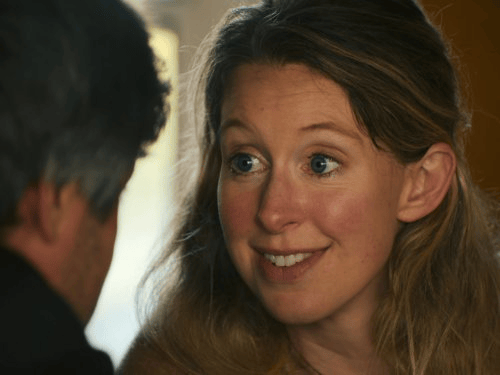
Thirty-four days prior to her 11-year prison sentence, which was set to begin on May 30, 2023, Elizabeth Holmes welcomed a documentary crew into the house she was renting with her romantic partner Billy Evans. The idea, according to Holmes, was to get her story out to the public as a way to clear the air: Was she, the former CEO and board chair of Theranos, actually guilty of the crimes of defrauding her investors that placed her in this scenario, or was it all some kind of conspiratorial set-up to shut down a life-saving and world-changing medical device before it could be patented? The documentary You Can See Everything isn’t actually about the answer to that question, because this is no ordinary documentary or crew.
To be clear, for the span of a couple of memorable scenes, the film and its makers are certainly interested in the events that revealed Holmes to be a complete, total fraud. The first has the film’s primary director and interviewer trying to understand the ins and outs of the device, which was said to be able to perform any medical test and send information from a digital cloud back down to the device, which would provide results from a single droplet of blood. At this point, it should be said that the person interviewing Holmes is Nathan Fielder, the comedian whose brand of truth-seeking resides in some netherworld between provocation and performance art and actual revelation.
Yes, Fielder—alongside Lance Oppenheim as co-director—does finally seem to understand what the device is going to do and even, in some way, clarifies what exactly Holmes was trying to communicate to the public about it. That’s the first of the two scenes in which Fielder attempts to dissect Holmes’ ability (or lack thereof) to communicate, but the second one is sort of an indescribable magic trick—until the veil drops. Let’s just say it involves the oldest and most famous comedy routine of all time, and leave it at that.
So much of this documentary, in fact, begs the film critic to “leave it at that,” because this is a wild experience, beginning as one thing—a document of Holmes’ final month with her family (and the documentary crew) before her imprisonment—and, after a noticeable gap of two years, becoming something else entirely. We’ll stick with the first part for a while, because even just that part is an astonishing coup of the documentary form, of the concept of access for the maker of said documentary, and of the idea that we can possibly, remotely understand a human enigma over the course of approximately two-thirds of the three-hour running time. Just the first half could be considered a monumental achievement, and so you, the reader, will just have to wonder how the second half elevates it into some uncharted echelon.
To start, the openness with which Holmes and, at least to some degree, Evans have welcomed Fielder into their home suggests pretty much exactly what we eventually find out: They are maybe not quite as aware of the comedian’s reputation or previous projects as Fielder has been led to believe in their earlier interactions with the studio that was approached to produce this project. Well, Holmes is not aware, at least. We’ll get to Evans in good time, because he takes over the story in such a memorable way that—its own achievement—steals the spotlight from the notorious and infamous white-collar criminal at the center of the story, the one who is about to serve a double-digit prison sentence and who was portrayed by a Hollywood A-lister in an award-winning limited series for a major streaming service.
We pity Holmes at least a little bit. Having made her own bed (with help, of course, from an ex-partner who may well be an invisible presence in one moment), the prospect of lying in it frightens her. Our pity is limited, of course, to the very basics of human sympathy, because, after all, she has a couple of pretty cute children now and a relationship with reality that has been humbled somewhat by her lot.
We fear Evans for the most part. The big question for Fielder, summed up in one of the film’s final scenes, is whether Holmes has been duped by this malignant narcissist’s self-possession or is herself a master manipulator. The answer really lies within Evans, though, whose thousand-yard stare remains whether he’s looking off in the distance of the neighboring sea or staring directly at Fielder himself from very close to his face, in a series of hushed and chilling conversations that, maybe, reveal a bit more than Evans would be willing to acknowledge.
We are fascinated by Fielder, who eventually becomes as much the subject of his own film as his actual subject does. The director often sits in the corner of a room, no matter if it’s the darkened bedroom, which feels sterile and anonymous in a way no married couple’s bedroom should, or the living room, where Holmes’ openness results in some of the biggest revelations here, or even the bathroom, where Evans’s complete freedom in front of the camera is revealed (almost assuredly as a way of marking his territory). The degree to which he does become his own subject of document, though, is only revealed in that second half—the part which, because of its nature, is so difficult to discuss.
Without revealing anything substantial, it features Fielder seeking some psychological grasp of Holmes through an unexpected source, offers the unspoken source a chance to re-filter it through a particular prism, and, ultimately, upends all of that by establishing quite clearly the difference between what Fielder has made his career—the performance-art provocation—and when to recognize the real, uncensored thing. That might sound maddeningly vague, but it’s just another way of establishing how insane, how unlikely, and how unpredictable all of this turns out to be. The documentary folds in upon itself, even exploring the various contracts that led to its production, in a way that necessarily interrogates what level of exploitation Fielder might or might be working on, intentionally or not.
The result is a magic trick much in the way that moment involving the comedy routine turns out to be, but the final moments of You Can See Everything witness Fielder trying—and, for what it’s worth, failing—to understand what is essentially inscrutable. The human personality, of course, is like that sometimes, and some things will always be just beyond our grasp.
Rating: **** (out of ****)


Leave a Reply