When it comes to remaking older films, it would behoove directors to find some way of making the new version their own. Director Julio Quintana kind of understands that but, in important ways, doesn’t understand it enough in Angel and the Badman, a still-quaint update of the 1947 film of the same name. It retains, almost precisely, the same story trajectory, and that story does remain a touchingly low-key one, about a man whose life has been marked by violence crossing paths with a family whose world view has been shaped by grace.
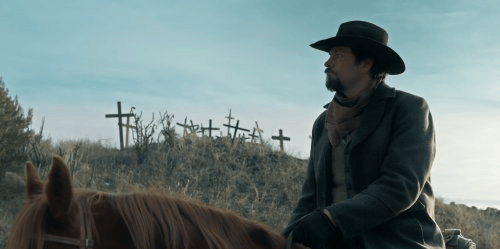
In the ways that screenwriters Kevin Townsend, Christopher Tuffin and Jaime Hernandez have stayed true to the original story, the movie still does remain basically compelling, although there was something in James Edward Grant’s direction of the original and in the overall aim of the film’s own world view that gets lost in translation here. We do get those basics, which practically smash-cut the viewer right into the middle of an ongoing story. Quirt Evans (Zachary Levi) is in the middle of a shootout, has been shot in the stomach, and winds up on the front porch of a devoutly religious family who have no idea how to help him but in the ways they can.
This is the same, of course, but almost immediately, the filmmakers adjust our expectations of how this family will help in a particularly contrived way: One might recall that the helpful family in the original was made up of Quakers, who rejected violence to such a degree that they disallowed the presence of a handgun, even in an early brush with danger. Here, the Worth family are Christians—likely Presbyterian, though the film never specifies—and do not quite have the same objections. Sure, they’re nervous around the gun, but they’re also curious and only stash its bullets elsewhere while keeping the thing itself within reach.
One can also rest assured that, at some point (and likely because of the studio behind it, who once again interrupt the credits to sell more tickets—framed as a stick-up by the film’s villain and, therefore, quite aggressive), the movie will attempt to preach directly at Quirt and, by extension, us. This is fine in theory, although the original did not try to turn its audience into Quakers. The point of the story, after all, was both more specific and a little broader than any particular religious practice or belief, and indeed, the attempt here comes across as kind of random, since it’s never brought up again.
There are also the even-smaller differences here, such as how Neal McDonough incorporates a mysterious and gimmicky cough as the antagonist Laredo Stevens, whose reputation—like Quirt’s—proceeds him. McDonough uses his steely gaze and an intimidating stillness to command control of a room, and by all accounts, the usually solid actor is, as usual, solid here. That also goes for the reliable Tommy Lee Jones, who is probably the only actor still alive who could recapture some of Harry Carey’s no-nonsense wryness in the role of the town’s U.S. Marshal, Wistful McClintock.
Then again, Levi is no John Wayne, who essayed the original role of Quirt Evans with the typical amount of machismo we attribute to the legendary actor but with a gradual soulfulness that chipped away at the jaded and violent exterior. Here, Levi just showcases some generic swagger and flashes his pearly-white smile. There’s a wide distance between genuine star power and a generically heroic posture, and this movie provides that proof.
Yes, the points of the plot otherwise remain the same, as Quirt holes up in the quaint Christian home of the Worths, including the pretty Penny (Meg Fraser), her son Johnny (Barrett Ellis Luca) and mother Irene (Jean Louisa Kelly), and the wacky family matriarch Harriet (Melissa Chambers). They nurse him back to health, pray for him, ponder over the circumstances—both literal and providential—that led him here, and batten down the hatches in the eventual face-off with Laredo and his two henchmen. That it all builds to the said face-off is another difference and also another problem.
After all, the original was ostensibly all about the process of internal change for a man who never thought or imagined that he could, with the prospect of his violent past catching up with him slightly secondary to the characters within the plot. With this new Angel and the Badman, the more modernized take means we need the showdown, the satisfying comeuppances and the promise of a happy ending.
Rating: **½ (out of ****)


Leave a Reply