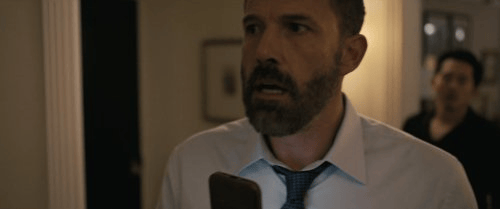
A man of stature and with a certain amount of privilege and pedigree is called by an anonymous individual, who claims to have kidnapped his son and will ransom him for a seven-figure sum, to be delivered at a time and place of the kidnapper’s choosing. This is a fairly common thriller scenario, of course, but it is also the plot of Animals, a film with a very specific—but never credited—source of inspiration. One will recall a classic of non-English language cinema about a shoe company executive who finds himself in the same scenario, and one hopefully recalls its underappreciated remake (released just a year ago from this writing) that recast the role as a music industry mogul.
There is nothing wrong, of course, with taking inspiration from a previous movie, especially one as good as that original film, as long as one has a plan for how to set it apart. Here, a trio of screenwriters—Connor O. McIntyre, Billy Ray and director/star Ben Affleck—come up with the least useful ideas about how to flesh the tightly wound story beyond its breaking point. As one example, the script makes a bigger role out of the wife of the powerful man, giving her a secret of her own that, at one point, is used for the purposes of the melodrama unfolding behind the scenes of the central scenario.
It’s a wholly banal sort of misadventure, entirely contrived to place a wedge between Mark (Affleck), the privileged man in question, and Abigail (Kerry Washington), his wife. It wouldn’t take too much effort to figure out what that secret is, but it does take some to figure out why the filmmakers would even include it as a plot point when the movie proceeds to do nothing with either the fact or whatever consequences might come of it. Another example of storytelling thoughtlessness here is that Mark, a populist running for mayor of Los Angeles, is not really in the pressure cooker that his characteristic forebears were: In other words, he might have less money than he says and need to borrow it from a shady source, but the stakes are not quite as high on account of some deal that’s about to go through.
That is an important—crucial, even—difference between this story and the one that came before, from which it repeatedly tries to escape, only to force us to consider them on the same playing field. Instead of a business background, Mark is an aspiring politician with all the charisma and secrets that accompany the area of interest, which means that Affleck and his co-screenwriters are interested in something more than the straightforward and moralist message we might be expecting. That resides in the tragic bit of irony that drives the rest of the story, when it turns out that the kidnappers made a fairly sizable blunder in their abduction.
For a while after the variation-heavy set-up, the trajectory of the story remains the same: Mark and Abigail need to find the money, the campaign’s manager Sam (Steven Yeun) suggests a few face-saving options, and ultimately employs the help of a “fixer” played by an ice-cold Gillian Anderson. She’s Dayle, and she’s the one who will need her fee without any exceptions or mercy for this poor family’s troubles. There is another “poor family” in need of help, though to comment on the reason for the presence of Ramon (Luis Gerardo Mendez), the gardener, or his wife Cecilia (Adriana Paz), the kids’ nanny, would be to say too much about that tragic bit of irony.
Where the movie once again attempts to set itself apart is in a third act that changes a whole lot about the immediate stakes of the situation, as well as the full or half measures used to get the money in the hands of the kidnappers. Yes, there’s still a shootout of sorts, and yes, it does involve various acts of misplaced machismo. It is also—to put it diplomatically—bunk in the lowest form, morphing a morally cynical and ethically murky situation into a finale fit for a much less elegant thriller and followed by a series of final scenes whose naïve message can be boiled down to how two-sided and self-serving politicians can be.
That’s not really a spoiler for what happens in Animals, by the way, but it is the best way of illustrating how and why this movie goes wrong in the ways that it does (more specifically to the production, it’s flatly photographed by Robert Elswit and performed throughout, with the exception of Anderson, as a series of hushed or shouting arguments). The foundational story here is worthwhile, but it would serve one well to watch either of the two previous iterations than to engage with this wholly silly take on a well-worn story.
Rating: *½ (out of ****)


Leave a Reply