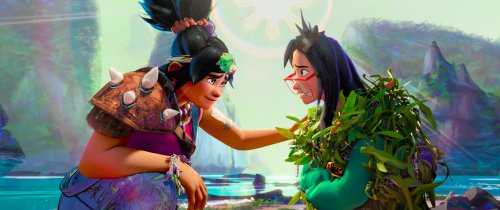
Barely able to contain its own inventiveness, Forgotten Island weaves an exciting adventure tale, rooted in Filipino folklore, but even more deeply resonates as a story about two teenage girls trying to hold onto why they became friends in the first place. We all grow up and drift away from even our closest circles from youth, but with this brightly imaginative and genuinely entertaining animated fantasy, writers/directors Joel Crawford and Januel Mercado really get at the bonds that are everlasting. They’re right there in the stakes of the movie, which eventually place those bonds—and the memories that feed them—on a literal chopping block.
As children, Jo (voice of Kailey Crawford) and Raissa (voice of Kayla Teruel) were outsiders of a sort—the former for her creative spirit and the latter for her quiescence. Raissa sticks up for Jo after a class presentation about family history, which the teacher thinks has become fantasy out of myth, lands her in the principal’s office. The experience immediately inspires Jo to ask Raissa, who has never had one, to be her best friend, and in the rush of an opening montage, we get to see the pieces of a once-in-a-blue-moon friendship.
It’s a strength of this screenplay, though, that the end of the montage brings the prospect of parting ways and, with it, the realization that a lot of things settled themselves upon these two girls’ hearts in the interim. Raissa (now voiced by Liza Soberano) has received an opportunity to go to college in America, at the prestigious California Institute of Technology, where she plans to study space exploration. Jo (now voiced by H.E.R.), always thinking that her best friend might want to stay near Manila, is disappointed on her own behalf by this news, barely able to muster up the enthusiasm to be supportive of her friend.
In the background of this part of the story, there is the omnipresence of a land out of Filipino folklore—the forgotten island (naturally) of Nakali, where Jo’s fun-loving grandmother Fatima (voice of Dolly De Leon) claims to have gone and where the two girls swear an oath to visit, if they ever discover that it’s real. Naturally, following grandma’s death and on the very eve of Raissa’s departure for California, a portal opens to Nakali, and Jo practically forces Raissa to follow her inside. This is where the film becomes an adventure tale, premised upon a surprising and funny scenario.
They don’t simply travel the portal to the other side, after all: They arrive 12 hours later, having experienced things in the interim that they can no longer remember, but which have left their marks—in some cases, like a conspicuous tattoo and a sizable chunk of missing hair, painfully so. The sense of mission here can be occasionally overwhelming, but the gist of it is that they need to find a magical sand dollar, which acts as a key to the portal and their only way home, where Raissa’s flight to college awaits. That’s a simple-enough mission, but of course, the journey is far from simple at all.
The surest thing to be said is that this is an extraordinarily imaginative effort from Crawford, Mercado and their team of animation supervisors and producers, who have crafted a visual representation of a mythical world that immediately strikes one as worthy of multiple sequels and maybe even one of those limited streaming series that are so popular these days. Perhaps we should want fewer of those in general. This, with its vast jungles and busy market town and horizon of mountains and hills, is an exception, and the style, which is primarily 3-D but mixes in some cartoonish flourishes (and even some interludes that recall the early-2000s era of animated television to match the period in which the film is set), is exceptionally inventive and always—but not garishly—colorful.
The plot has Jo and Raissa partnering with Raww (voice of Dave Franco), a part-human part-dog who can’t control when he’s one of the two or between them, to find the portal key, and along the way, they meet some other characters, too. The filmmakers occasionally go a little overboard with these, such as a handsome merman named Mermahn (voice of Kevin McCann) who takes on a different form without aquatic sustenance and a vampiric demon-baby named Bungi (voice of Manny Jacinto) who has destructive mommy issues and a group of hardened warriors whose threats of physical torture would go further if they weren’t so adorable. They add color to the picture, though, to be sure, as well as a sense of discovery and surprise.
That extends to a pair of villains voiced by Jenny Slate and Lea Salonga, whose distinctive physical appearances are unsettling in ways that should not even be described in writing. It’s clever, though, how the climax is less about some physical confrontation or fight with these villains than it is about the opportunity to teach them something about themselves and about the outside world in the process. After the busy and slightly cluttered middle act, it’s a gift that the film calms down to give its apparent antagonists that sort of lesson.
It also marks a return to the concerns of the opening act, which is to say that Forgotten Island proves itself, especially in the ways that count, to be all about this central friendship. It might follow a particular formula as an adventure tale, but that climax—which travels into the very consciousness of its characters to plumb their memories—is something special, indeed.
Rating: *** (out of ****)


Leave a comment