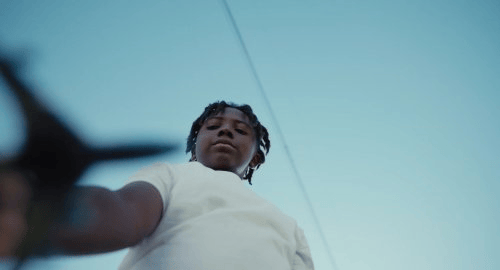
In the Watts neighborhood resides an entire generation of African American families, dating back to its initial development as a city independent of wider Los Angeles. That changed in the mid-1920s, when the smaller neighborhood and the bigger city consolidated, and within a couple decades of that point, racialist covenants had been passed to restrict African American housing within Watts and one other district. This is important background information when it comes to considering If I Go Will They Miss Me, a domestic drama in which whispers of this collective past drive the painful present of a single family living in these projects.
This is not, to be clear, an overtly political or polemical piece about the history of Watts, knowledge of which (unless already known) takes a bit of actual research, but a small and rather delicate drama about fathers and sons and the legacies that bind them. Still, when part of those legacies is having grown up in a neighborhood like Watts, which has by now developed a probably unfair reputation for being low-income and high-crime (as if those qualities should make up the reputation of a neighborhood or district or city), one can imagine that its residents feel some link to the origin of the place. In Walter Thompson-Hernandez’ feature-length expansion of his 2022 short, that specifically looks like three generations of men—one of whom died some time ago, the other two of whom are his son and grandson—who once dreamed of flying.
That dream never materialized for “Big Ant” (J. Alphonse Nicholson), and one spends the film hoping it will turn out well for “Lil Ant” (Bodhi Dell), his father’s namesake (both names are shorthand for “Anthony”) and—for better and worse—quite obviously his pride and joy. Big Ant has been in and out of prison for reasons that are inescapably his own fault and also the result of an imbalanced justice system that doesn’t exactly favor men of his color. The resulting drudgery doesn’t mean he has no love for the son he barely knows, but it does mean that the love manifests in ways that often, to the boy, look like disinterest or disappointment.
Now that Big Ant has lived the life he’s lived, he can barely get excited about school-boy awards or accomplishments, and because of that apparent detachment from some kind of active living around his son, the boy’s mother Lo (Danielle Brooks, in a tremendous performance of stern compassion) misreads it—as we all might—as incurious. There is a turning point in this family unit at a certain moment in the narrative, which is less of a narrative than a slice of life or a collection of moments. It doesn’t come, though, until much later, after the father has proven that he has the capacity for love but not the disposition to show it.
If Big Ant has stopped dreaming, as a response to a life that has offered him no reason to continue, then Lil Ant is still a dreamer, visited by visions of himself and his father in the tradition of Greek mythology. The wings are the point, because of course, the boy wishes he could fly away from this place. The father, once again stymied by his own inability to connect with his son on any level that will be truly useful, stamps out those dreams—though the film argues that no such action here is meant to be discouraging or abusive in any real sense.
Big Ant simply doesn’t know how else to be, and for the record, his marriage to Lo is less of a source of sympathy for the man than his shortcomings with his son (a daughter, played by Zaria Kelley, fairs better in the exchange). He is unfaithful to Lo, sometimes in ways that directly and negatively impact his relationship with Lo’s extended family, which includes a mother (played by J.J. Boone) and sister (played by Bre-Z) who just barely tolerate him. A better example of a father might actually be Big Ant’s best friend (played by Myles Bullock), who proves himself to be there for Lil Ant in the ways his father cannot.
The cumulative effect of all this is often devastating but essentially hopeful, at least for Lil Ant and in retaining something like a good life for the boy. Small moments here are beautifully wrought, like a truthful conversation between father and son about a grandfather, whom Big Ant does not like discussing if he can help it. Other moments are wrenching in their bluntness, like how Big Ant castigates his son for his drawings of the man that litter their small house—even when one of them is for a school assignment and a fairly significant portion of his grade.
These two performances are exceptional in the way they complement each other and stand alone. Dell has not a drop of precociousness here, approaching his role with absolute naturalism, even as Thompson-Hernandez’ directorial flourishes shine through in some of the outward style (a number of widescreen shots that take in an entire structure or the wholeness of the bluest sky are disorienting). Nicholson is truly great, especially in the late moments when a concerted effort meets the brick wall of sudden disappointment.
Through it all, the specter of legacy follows these characters, because we cannot help but hope that Lil Ant—when he either becomes “Big Ant” of his own right or drops the nickname—responds to the pressures of adulthood and responsibility more successfully than his father. If I Go Will They Miss Me does give us hope, but it also provides a heartfelt story, a cleanly divided perspective and an affecting view of humanity in the process.
Rating: ***½ (out of ****)


Leave a Reply