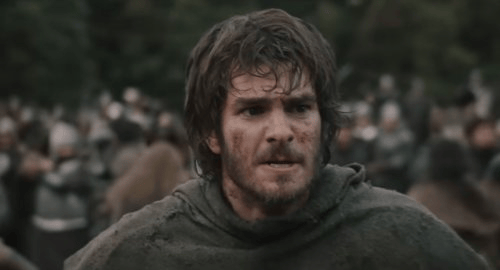
The effectiveness of The Uprising—as an action drama, as a historical piece, as a political thriller—resides almost entirely within the performance—lived-in, weary, determined—by Andrew Garfield as the film’s hero. The man is not simply a protagonist in director Paul Greengrass’s film, by the way, but a symbol, as indicated by the simplicity of his manufactured name, by his single-minded goal and, especially, by the inclusion of a major swing for the fences in the final few minutes of the story here. Details about those final minutes should, of course, not be revealed, even if the studio’s marketing team has beat it to the punch, but let’s only say that Greengrass places the righteous outrage and the hero’s mission into an instantly iconic and recognizable context.
It’s a gimmick, in other words, but one informed by the sober thematic concerns of everything that happens before it. The year is 1381, just as Europe at large has finished counting those who died during “the Sickness”—which, of course, will later be known as the “Black Death.” Garfield plays a farmer who might as well be nameless but gives himself the moniker of “Ploughman” for a simply and succinctly stated reason: “I am what I do.”
Another way to look at this name, of course, is that Ploughman is a late-14th century superhero, with its anthropological suffix and his own air of mystique, which convinces everyone in the man’s vicinity—to include us—that he cannot simply be “just a farmer,” as he tells his king during a key scene here. Garfield himself is not an especially imposing or intimidating figure, but Ploughman, in the film’s third scene, intervenes in the imposition of a tax upon the common people of England in a particularly conspicuous way. It involves overpowering so many of the King’s guard, with one man’s head bashed in quite horizontally, that word reaches the King and his council forthwith.
In these few moments, Greengrass and Garfield convince us of both the capability and the righteousness of Ploughman’s mission, because the scene that had been staged was already a giant mess before the man made it a bloody one. The imposition of the tax brought with it an order to fulfill the King’s wishes whatever the outcome, and part of the strategy involves subjecting the young women—some of them actually girls—to the humiliation of “checking” them for proof of their, well, natural age. Garfield uses this scene to establish a few things about his performance, and there’s a subtly crucial one among the lot.
Ploughman is defined by a constant rotational evolution, as his uncertainty and doubt about how far he himself is willing to go change with the introduction of new information. It’s apparent in this scene, as the confounding terms of the new tax—which, for him, may involve a further death tax on his late wife and children until he can prove with documents that they died in the sickness—are compounded by the savagery of the guards. At first, he’s merely worried about his own wellbeing, and then it’s around the third or fourth “examination” of a nearby village woman that something like decisiveness settles upon his visage, leading to the biblical rage that ends in the bloody heroics.
The plot here is fairly straightforward, as Ploughman joins forces with a few others of similar mindsets—chief among them, rebellion leader Wat Tyler (Cosmo Jarvis), a branded heretic of a priest named John Ball (Jamie Bell), and militantly political clergyman Alyce (Thomasin McKenzie)—and marches to petition Richard II (Woody Norman). The king, by the way, is but a 14-year-old boy here, and his council, including men played by Tom Hollander and Stephen Dillane, treat him as such, while his queen mother (Katherine Waterston) prays at her late husband’s casket for guidance and clarity. Those men seem to want to make the boy-king’s decisions for him, but Richard, as played by a coldly impetuous Norman, is a lot sharper than anyone around him expects him to be.
The key scene here is a meeting of the conflict’s two sides, with a handful of the rebels facing the king, his mother and the Mayor of London (an impressively mustachioed Jonny Lee Miller) for a powwow about the issues that separate them. It’s a scene that, through but a series of close-ups and a handful of monologues, shifts the dynamics between the two sides in predictably irrevocable ways. The stage is certainly set for a climax that, as anyone familiar with the history of this period and the specific historical figures involved will recall, goes quite badly.
The political backbone of Greengrass’s filmmaking here is sturdy, as the conceit of aggrieved masses protesting their imposing government’s continuing to finance a foreign war will, of course, resonate even today, and while those final minutes—a denouement set a few years into the future—are sure to be divisive, placing them within a romantic context also seems quite logical. The Uprising understands that stories like this are bound to become the stuff of legend, and even if Greengrass gives in to a gimmick by making it the stuff of a particular, recognizable legend, the ideas here still shine out the clearer.
Rating: *** (out of ****)


Leave a Reply