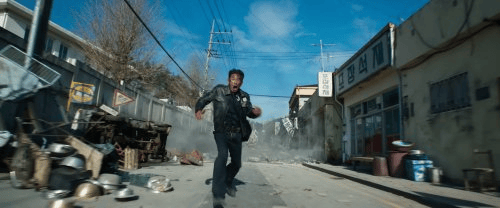
If nothing else, Hope offers a good reminder of the difference between “convincing” and “realistic” as the adjectives to describe a movie’s visual effects. To get it out of the way, no, the monster(s) in writer/director Na Hong-jin’s movie is not realistic but has been digitally animated in such a fashion that its movements are jerky and imprecise, as if the animators put in only about two-thirds the effort they could have. That’s where the “convincing” part comes in, because despite or because of all that, we’re never less than terrified or in awe of these beings, which have chosen to terrorize in a remote South Korean village where unregistered guns have been outlawed and paranoid nationalism seems to be the resting pulse of the people who reside there.
The movie starts and barely stops for anything but action or exposition, and the fact that Na keeps the momentum at such a pace is both admirable and formidable, because the movie is more than two-and-a-half hours in length. One whole hour is spent building up to our first glimpse of the monster, as a few characters are engaged in something of a mystery upon the discovery of a mutilated bull. This is where the film’s other effects specialty—that of truly horrifying, semi-organic props—gives us our first glimpse of Na’s visual ambition, because it looks like a real bull with real, gouging wounds and an air of being able to smell the body in the air around it.
Both of the film’s priorities around its effects work—the digital kind and this more analog work of prosthetics and gore—will become important as the film’s fairly straightforward, but interwoven, plot plays out. The bull’s corpse alerts local police chief Bum-seok (Hwang Jung-min) to the presence of something in the village of Hope Harbor, and it is, indeed, quite a thing that has targeted the town for some type of attack. For a while, Na’s game is to tease us with the constant, but offscreen, presence of the beast or being.
We hear its roars, see the devastation of its carnage in a few moments of jarringly immediate violence or by way of the actual bloody aftermath left in its wake, and, through Hwang’s well-modulated performance, feel the qualities of terror and panic that it inspires without needing to see it for ourselves. Any amount of build-up for this long and with this degree of suggestion seems doomed to underwhelm once we meet the beast. That’s why the opening notes about the quality of visual effects are so important in this case.
The monster, which it would be criminal to describe in any actual detail, is tall, thin, frightening in its velocity and in its aim with whatever nearby object it has decided to throw, and—most importantly—terribly sad in its haunting beauty. The obviousness of the pixels with which it was crafted have nothing on those less tangible qualities, and that extends to the appearance of later monsters. These other beings are decidedly not of this earth, and buried underneath those pixels are the approximations of a few familiar faces—actors who are allowed the opportunity to turn movie monsters into characters of real consequence at the very last moment.
There are distractions here, such as how those monsters become real characters right as the movie ends (with a sequel stinger of sorts and an abrupt ending that could also be read as a hopeless cliffhanger) and how the middle act of characters explaining everything to each other seems to exist for the purpose of being bookended by spectacle. Hwang teams up with a rookie cop (played by Hoyeon) to chase the monster and the clues it leaves behind, while a local group of hunters, led by Sung-ki (Zo In-sung), stumble upon something in the forest that turns all of them into targets. In between is a lot of talking—about the monsters, about what might have brought them here, about a particular monster killed by the village idiot and, in the film’s funniest moment, about a need to do some secondary business in the forest that led to a horrifying discovery.
Na introduces a welcome sense of humor at the edges of all this, like how that story about the need of a bathroom break just keeps going with the gory details of a bowel movement, but it never wholly undermines the terror of the scenario, like how we slowly stop laughing entirely at that story as it reaches its conclusion. Na expertly handles the inherent tonal dissonance of all this in time for a haunting climax that melds otherworldly revelation with another set piece of stirring action and violence. Only occasionally, as with one bit of punctual violence that feels like overkill (pardon the pun), does the filmmaker’s ambition in that department get the best of him.
Hope rides on its ambition throughout, stumbling only when it feels the need to situate us within a lore that barely seems to be developed beyond the basic building blocks. It’s all about spectacle for Na, and the knock-down, drag-out, gun-wielding chase sequences—elegantly framed and blocked to enhance our experience with its big-screen pleasures—truly do spectacularly deliver.
Rating: *** (out of ****)


Leave a comment