Layers of metatextual reference reveal deeper layers of identity, sexuality, iconography and legacy in Teenage Sex and Death at Camp Miasma, the third film from writer/director Jane Schoenbrun and likely the clearest example of a genre exercise—or two—that they have given us. One wonders all the way through this explosion of creativity and self-awareness whether some small part of it is autobiographical. Surely the director, whose last film, 2024’s I Saw the TV Glow, exhibited a tangible command of its own genre elements and aesthetic, was asked by some studio to revive a cult classic within the genre right?
Perhaps that’s why the parts of this movie that don’t feel like an exercise in horror or satire adopt the feeling and vibe of something akin to an exorcism. One would be foolish to approach a filmmaker like Schoenbrun and expect them to take on a horror franchise with anything like reverence for the commercial or studio dictates of such a project. To whatever degree this movie showcases anything commercial, well, at least it more or less embraces its horror and surrealist imagery in a way that might satiate those walking into it without any idea what to expect.
What enhances the film’s mystique and cumulative effect is that everything mentioned in the previous paragraph comes into play for its protagonist, too, an indie filmmaker who has been asked to revive a once-popular, now-oversaturated horror franchise. An amusing detail here is that Camp Miasma, the series in question, seems to have gone to space several installments ago, which means that it’s no wonder the powers-that-be are looking for new blood to invigorate it. Kris Williams (Hannah Einbinder) represents the new wave of socially aware horror directors that we’ve seen here in our real world, while also obviously representing Schoenbrun more specifically.
If some of this story reflects whatever recent experiences Schoenbrun might have had as a suddenly in-demand filmmaker approached by a major studio, then one also must wonder the other character in this screenplay also represents anyone specific. We will probably never know the answer to that question, of course, because the theoretical real-life project was, more than likely, protected by the legal binding of a nondisclosure agreement. Still, the plot has Kris seeking out a reclusive movie star to initiate some sort of conversation about returning to the role the star originated.
Isn’t this way of things these days? It has been for about a decade now, and the move has been particularly popular in the horror genre, where the icons of old joined the up-and-coming new to tell some story caught between trying to move forward and looking wistfully behind. When what resides in the past is also the source of one’s trauma, though, that act of nostalgia takes on an entirely different feeling.
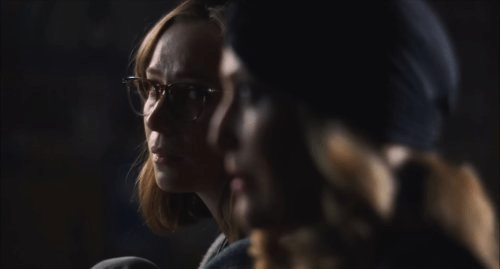
This is just one layer to a story that constantly evolves and folds in upon itself, but the dynamic that develops between Kris and Billy Presley (Gillian Anderson), the unearthed actress, is one of both an inherent generational divide and of deep, compassionate understanding. Kris emerges from this new class of filmmakers who seem to cracked the code of how to appeal to audiences and to shareholders by embracing the conscious elements of a new take on an old and “problematic” story. Billy comes from an older time, when—as she says—“flesh and fluids” were the primary concern and not gender identity or sexual preference.
They both have a point, but it’s all ultimately secondary to what each woman discovers about herself over the course of this interview process. Kris discovers certain unsavory truths behind the production of the first Camp Miasma, though she can’t dismiss entirely the very specific effect it had on her. Billy is reminded of old wounds, but with the help of Kris’ newer observations and perspective, she comes to realize that those old wounds rest at a kind of crossroads between violence and sexuality.
It’s not, of course, all talk and no bite here, as the presence of “Little Death” (Jack Haven)—the sexually ambiguous antagonist of the Camp Miasma franchise—bleeds into the real world (or does it?) to underline the curse Billy believes still resides in the place where she shot the first couple of installments. Beneath the lake, she says, something else lurks, and that “something” is at the heart of both the shattered pieces of Billy’s should-have-been career and Kris’ journey of complex self-discovery. Something about the conclusion at which Schoenbrun arrives feels a touch too literal for the kind of allegorical point being made.
Maybe that, though, is part of the point of a movie with a title as blunt as Teenage Sex and Death at Camp Miasma, which also has a larger satirical target—and some fun exploiting it, as in a scene involving a video conference with those executives (Dylan Baker appears as a particularly dense one, who only seems to understand things literally). In its central relationship, and in the emotionally precise performances from Einbinder and Anderson, the film finds its footing as a keen act of film analysis and a study of what “legacy sequel” means to those who helped to establish that legacy, for good and ill.
Rating: ***½ (out of ****)


Leave a comment