It is a generally understood rule that, if you’ve introduced into your horror movie a stuffed, animatronic, smiling cactus programmed to repeat whatever you say, you’re probably going to bring it back as part of the scare tactics you’ve established throughout. To his credit, writer/director Jacob Chase does just that in Insidious: Out of the Further, the sixth installment in the unlikely franchise (which began all the way back in 2011 with the capable fright fest that was the original) but also something of a reboot. The toy cactus, in fact, is the culprit of one of the cleverest bits of machinery that Chase has up his sleeve.
The toy works because of how little sense it makes in just about any context, which in this case involves the manufacturer somehow being able to program it to “hear” the speech of the dead, traveling to our realm from the netherworld they populate. One can probably guess how the scene plays out with those clues, but the predictability here isn’t really the ultimate problem with this movie. Indeed, it’s sort of a relief that Chase gives us a clear idea of what he’s going to do here and then, with general aplomb, fulfills those obligations.
Perhaps, then, the “obligations” are ultimately the problem. One will recall the original film, plus two of the four sequels that followed, and its family targeted by spirits from “the Further,” which the third and fourth movies in the franchise basically ignored in favor of another common character. That would be Lin Shaye’s Elise, the clairvoyant who died in the first movie but somehow kept coming back as the most important character of the lot (hey, it’s a good way to keep Shaye employed, at least).
Elise makes an appearance this time, too, although Chase makes it quite plain that she is very, very dead by making her something of a tour guide through the accursed afterlife that awaits all the nasty spirits doing their worst to the living characters of this world. The narrative, instead, is once again focused upon a specific person, as well as that person’s daughter and boyfriend, as they come into contact with the Further and seek to understand it. Some of Chase’s screenplay, then, plays a bit of catch-up, as if its viewers won’t have spent the week or two prior re-watching all that had previously happened.
The aspects of this story that are not playing catch-up are clearly and decisively much, much better than its franchise-centered priorities: Gemma (Amelia Eve—looking so much like Naomi Watts that it’s distracting for long stretches) is technically a single mother to her daughter Maya (Island Austin, wholly naturalistic), though a relationship with her police-officer boyfriend (played by Brandon Perea) is recent and has been making her happy. She just wants what’s best for Maya at the end of the day. Part of that involves moving into her childhood home, in spite or because of the trauma that resides there for herself.
Yes, this is another horror movie technically about how trauma haunts us all, though the specific and terrible horror at the center of Gemma’s trauma is specific enough, not to mention wholly understandable, for us to sympathize immediately. Whatever might have happened to Gemma’s mother in the bathroom of their home, it also came after a life driven by misery and drudgery. She drank quite a lot and had a few other, unspecified mental-health issues, and naturally those were exacerbated by the demons or bad spirits or whatever lurking inside.
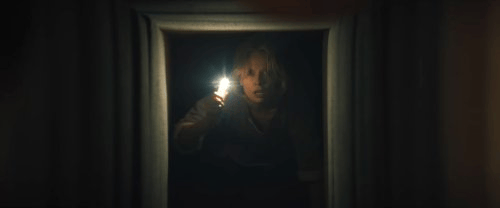
For a while, just this angle to the story is enough, as Gemma and Maya are terrorized in their home by the spirits, which take the physical form of some creepy neighbors. Chase takes advantage of the opportunity to stage some set pieces of diabolical creativity and effectiveness. The squeamish ought to be hiding behind their hands when Gemma, a dentist, examines the teeth of the old-man neighbor, which are hiding more than rot and plaque, but the best one is a maze of a pillow fort, which extends for dozens of feet and features faces popping out from unexpected corners or—especially chilling—staying put no matter where the camera is.
If the movie had been solely devoted to this, it could have been worthwhile. It ultimately does give in to the pull of the franchise with a couple of characters—Elise, obviously, as well as a tattoo artist (played by Maisie Richardson-Sellers) who acts as her acolyte—here for the expository dialogue and a climax that, because of all the exposition, is rendered quite confused and chaotic. Insidious: Out of the Further is an improvement upon a few of the other movies in this franchise, but a few too many layers of nostalgia still underwhelm.
Rating: **½ (out of ****)


Leave a comment