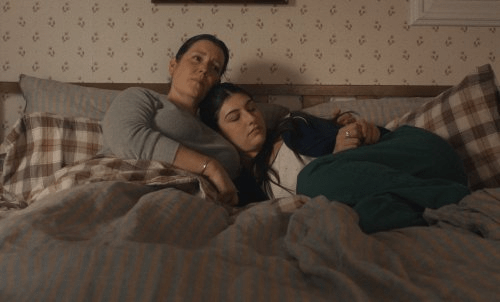
Don’t Say Good Luck aches for its fragile, thoroughly human characters, and that might be the greatest accomplishment of a well-rounded screenplay, written by Laura Hankin, director Julia Hart and Jordan Horowitz. Structurally and subjectively, it’s not exactly a new-seeming story, tracing the coming-of-age of a teenaged girl as she navigates a few formative events and one sizable family crisis. Truth comes from such familiarity, though, and within this familiar story, Hart finds a whole lot of aching truth.
The girl in question is Sophie Birenbaum (Sunny Sandler—daughter of Adam and Jackie, who both unsurprisingly served as producers on the project), who is facing a lot all at the same time. She’s on the cusp of learning to drive, that action so integral to the concept of a young person’s freedom, and she’s about to audition for a school play, a production of Sara Bareilles and Jessie Nelson’s Waitress in which she is one of a few students vying for the lead role. Most importantly, she’s of the age where flirtatious crushes could become something a little more serious, though it all starts with the promise of a kiss.
The first thing to say is that Sandler is absolutely exceptional here at juggling each of these disparate and quite distinctive modes of subtle anxiety, and that’s before the universe throws a dark cosmic joke in Sophie’s direction. Her mother Elizabeth (Melanie Lynskey) is re-diagnosed with cancer after having apparently beaten the disease before, and although that might mean the family must restructure all of its priorities, mom makes quite sure that it actually means no such thing. She wants the best for all of them, and maybe that doesn’t have to be a complete overhaul of their lives.
After all, the diagnosis comes on the very day Sophie is auditioning, alongside her best friend Carolyn (Scarlett Estevez), for whatever role she can get (Elyse Bell plays the bubbly eventual rival of Sophie’s, whose competitiveness masks a softer side that comes out in a particularly touching pair of calming moments). She doesn’t even hear the diagnosis as properly stated by her mom or her father Ted (Max Greenfield), but through a butt-dialed call of out-of-context sobbing and commiseration. When she gets the Waitress role, her instinct is to whisper it, almost out of reverence for everything else going on in the family.
The “plot” of the film, then, is simply Sophie’s navigation of all this, as Elizabeth’s diagnosis and eventual prognosis hang over the proceedings like a black veil, with the arrival of her parents (played by Steve Buscemi and Bebe Neuwirth) a particular source of strain and more anxiety. Lynskey is somehow a revelation in every role she takes on, and this is no different, as the actress subtly alters the character’s physical mobility and some light makeup work does the rest to convey the spread of the cancer. Greenfield is strong in his handful of appearances, too, knowing exactly how to step back and rein in his usual comic impulses to be generous to his co-stars.
Away from the house, Sophie must contend with the school play, whose director (played by Stephanie Beatriz) keeps asking her star to draw from experiences at home without having a full picture of what’s going on there, and with the various production issues that arise. Her crush is Jack (Jack Champion), who is also her co-lead and suggests they “practice kissing” for reasons Sophie believes to be innocent. Meanwhile, Carolyn inexplicably begins to withdraw from the friendship and spend time with another girl, all while concealing her own truth in order to guard her heart and Sophie’s.
The other characters, then, are just as important within this calculus to contribute to the air of sincerity and sweetness for which Hart and the actors are going. This is a meaningful ensemble, extended to the various schoolkids in the play and even random, smaller roles, like the deli owner played by Jon Lovitz, who is just here for comic relief that actually feels like a bit of levity. Hart’s direction is low-key but always deliberate, allowing for the simple tricks of the trade—curated close-ups, characters walking in on misunderstandings and minor revelations, a final montage that mixes a crucial stage performance with images of closure—to do their best.
In other words, this is a good film—not only in terms of its delicate craft, but also because of its positive, heartsore world view that, even as we face death, everything is going to be ok. The final shot of Don’t Say Good Luck is an embrace that shows us and its characters exactly that sentiment.
Rating: *** (out of ****)


Leave a Reply