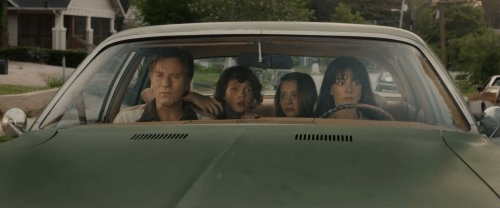
If one were inside of a subjectively silly scenario like the one at the center of The End of Oak Street, it wouldn’t feel silly at all, and that’s why the seriousness with which writer/director David Robert Mitchell—yet again telling a story in the suburbs, which is the one thing that unites each of his movies until now—takes this scenario is so very appreciated. The story here follows a comfortable family of four, living in an anonymous neighborhood that could really be anywhere in the Midwest of the United States, as they run, hide or fight in the wake of the sudden and alarming appearance of dinosaurs in their neighborhood. There is an explanation for their presence, and that’s the very silly thing indicated above.
It’s also something of a surprise, so let’s just say that the presence of Late Cretaceous-era dinosaurs and flora is both not at all a coincidence and something of a cosmic joke. A person recently enamored with the writings of Carl Sagan suggests that wormholes might be involved, but whether they are or are not (this review won’t be the place to find out, of course), no such explanation or, by extension, comfort will be afforded here. Mitchell’s screenplay is boiled to the essence of its scenario, which is the run-hide-or-fight part.
To his credit, though, the filmmaker has also given us a family ensemble of richly defined and thoroughly distinctive characters here, none of whom are simple or simplistic. They’re the Platts: Greg (Ewan McGregor) is an alcoholic, though whether he’s recovering or not is sort of an open question. That question is constantly being asked by his wife Denise (Anne Hathaway), who is embarrassed that her husband must make pizza deliveries to provide his part of the family’s income, and their children, the science-loving Audrey (Maisy Stella) and the slightly reckless Brian (Christian Convery), are distinct in personality, too. Audrey is prone to enjoying a lonesome night, but Brian is out sticking rods into the spokes of a neighborhood kid’s bike and enraging the older, bigger brother of said kid.
It’s refreshing to find a movie family with warts and regrets and insecurities and reasons to feel like any, old suburban family before the film throws them into the deep end of such a strange, high-concept scenario. The performances here reflect that, as we like these characters the more they feel dysfunctional, resulting in a paradoxical unity that intensifies as soon as the movie puts pedal to metal. Hathaway is particularly good as a wife and mother slowly losing her sense of stability in the family (an emotion that will be greatly enhanced when the running starts), and Stella ably communicates Audrey’s fragility, buried under an outward appearance of confidence.
Basically, the change happens overnight, indicated by a series of blinding lights and—in one instance—a depressurization to indicate a shift in both physical status and sea level. No one immediately notices a difference in their surroundings until the appearance of the dinosaurs—feathered, as scientific findings have recently informed us, and quite terrifying in their size and speed. That there seems to be no exit beyond the end of the block is alarming, of course, but the reason—a stretch of forest that now seems to surround the neighborhood—is downright inexplicable.
Then, the dinosaur attacks begin, naturally framing as predators hunting their prey, and Mitchell refuses to dumb down, solely for the purpose of a PG-13 rating that will undoubtedly bring in families of all ages and types, the violence of these attacks on the humans. Yes, there are cutaways—in one notable instance, for the decency of a truly shocking moment—but the point is communicated nonetheless that these are creatures as savvy as they are savage. Shotgun cartridges might have an effect on the smaller dinosaurs, for instance, but when facing an allosaur (essentially the prehistoric period’s answer to a Tyrannosaurus rex), that obviously won’t be enough.
There are not set pieces here, so much as the majority of the film is one continuous set piece—or, perhaps, several concurrent ones spliced together—that builds and builds upon the same general idea and mines an overwhelming amount of spectacle from it. The Platts put aside their smaller problems or issues to come together in resourceful escape from whatever scenario they can possibly outrun, while the increasingly unsettling rotation of dinosaurs (brought to life with digital effects that, in this daylight-driven story, are more or less flawless) sneak or smash or slash their way through the houses and yards to eat the innocent. In the most terrifying set piece, a creature that looks a lot more like a serpent than anything else slithers through a home and, worse, seems to understand exactly where in the house to respond to an injury inflicted upon its body (not to mention the nightmare fuel layering its rows of sharpened teeth).
Eventually, Mitchell gets a tiny bit lost in the plot mechanics of whatever’s going on that brought all these horrors to this little community of suburbanites, including an ending that feels in a slight rush to conclude things. That’s fine in the long run and, really, a small quibble in The End of Oak Street, a truly thrilling throwback to the days when “science-fiction adventure” actually meant we were in for terror and spectacle in equal measure.
Rating: ***½ (out of ****)


Leave a Reply