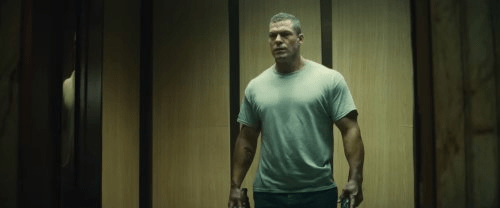
Boiled down to its basic elements, there’s nothing particularly special about Motor City, except that director Potsy Ponciroli has crafted a revenge picture of brute force, personified by the film’s massive and muscular hero. The screenplay, by Chad St. John, has already been boiled down to its basic elements, by the way, because now we reach the central storytelling gimmick here: With the exception of a few errant phrases, almost no one speaks in this movie, to each other or otherwise. That means a few things for the filmmakers and, probably, a few more for the actors in this ensemble.
Obviously, Ponciroli has set up something of an experiment with this movie, in which Alan Ritchson and Ben Foster play each side of a hero-villain coin, vying for the affection of Shailene Woodley as the woman they both either love or desire, while the hero labors to free himself from prisons both literal and psychological after he’s framed on a drug charge. That’s the entirety of this movie’s plot, by the way, which could have been communicated through the regular method of storytelling. Ponciroli fancies himself a bit of a scientist here, though, hypothesizing that we might get more out of a traditional revenge picture by altering the way we usually interact with them.
The results of the hypothesis are that he’s mostly—and overall—correct in that assumption, while also cutting enough corners to make the experience a slightly frustrating one on occasion. There are several scenes here that could have done with at least a few exchanges of dialogue between characters who are sitting opposite each other at a table or feet from each other in a living-room set-up. We have no reason to suspect that this is the real world or to attach any expectations as if it is, but even with such conditions in place, we should expect characters sitting across from each other, containing multitudes as they do, to say something.
Part of the frustration is that Ponciroli even manufactures specific stylistic choices to avoid the possibility that anyone might speak up in this movie by framing an investigation by a cop (played by Ben McKenzie) from afar, so that only the last few, heated words between the policeman and Woodley’s Sophia are detected as she walks away. Backed into something of a corner, it’s also clear that a certain character’s sudden, jarring fate, which subtly rewires everything around it, is probably here for the purpose of keeping the experiment alive. But look at this review, making the movie sound much worse than it is.
The cinema, after all, is about movement and has been since its inception all those hundred and a couple dozen years ago, which is where Ponciroli’s interests lie. One might even argue that including St. John’s contributions to this is an act of folly beyond the courtesy of doing so, because the pieces of the plot are simple, straightforward and fundamentally easy to predict in the way they turn out. After all, we’ve already identified the hero and the villain here, and it’s no spoiler to reveal that the characters retain those identifiers all the way through.
On the basis of this experiment, then, the movie is, once again, a brutishly effective little thriller with only a couple things on its mind. It’s not studying revenge so much as giving us a good reason to believe Miller (Ritchson) will want to exact it upon Reynolds (Foster). Framing him with a drug charge for the sole purpose of stealing his woman is as good—and about as old—a reason as they come.
From this scenario, we receive the typical plot structure, beginning with a brief flash forward to inform us that Miller will face down someone in a car with a couple snub-nosed shotguns filled with bullets containing coins and an engagement ring. The structure is as simple as getting us from that flash forward back around to when it’s an event in the present, as Miller winds up in jail and plots his escape with a couple of allies (the main one being a prison guard played by Lionel Boyce). Reynolds, meanwhile, builds a life with Sophia, full of alleged love and threats of physical violence and a penchant for placing her under his control with the forced inhalation of an illicit substance (Pablo Schreiber plays his enforcer, a corrupt cop armed with a knife that will be central to an elevator-set fight sequence that spares no brutality).
It’s all basically a reason to give us a lot of brutal, bloody, occasionally gory (the moment involving a severed leg comes to mind) violence as Miller pummels his way toward Reynolds and Reynolds builds a small fortress around himself in preparation. Ponciroli and cinematographer John Matysiak capture everything as if all of humanity resides within magic hour, and the action is also driven by its soundtrack of hard-rock tunes (plus one soulfully romantic jam in an early montage). We gain a few cursory details about the characters, like that Miller’s a Vietnam vet who works in a factory, and actually, that’s more or less the single cursory detail we gain.
Motor City, then, is not much more than a mood piece, powered by a gimmick and peppered with bloody retribution. Ponciroli’s command of the mood, the gimmick, and a corker of a final scene, equal parts bold and laughable, affirm that he knows what he’s doing here.
Rating: *** (out of ****)


Leave a Reply