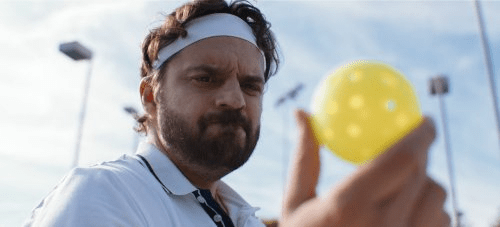
Perched precariously—but rather precisely—on the edge of parody, The Dink is mostly just a very funny sports comedy, riffing on the idea that the new ways always kill the old ways. That’s even and especially true here of the sport of tennis, which screenwriter Sean Clements and director Josh Greenbaum take very seriously within the context of their silly, riff-heavy comedy. In a fascinating tonal decision, they also take quite seriously the sport that, as a few of the characters here come to believe, is positioned to replace tennis—a frightening possibility for those characters, who have established something of a tennis empire.
It’s a constant reason to be grateful that these filmmakers know exactly what they’re doing along the road of this plot, which is also sort of a romantic comedy and, ultimately, a perceptive character study that happens to feature—just to bring it up again—a sort of parody of the world of competitive sports. In a certain way, it’s good news that Clements and Greenbaum take these sports and, to an extent, characters as seriously or, at least, sincerely as they do, because otherwise, it would just be an unadulterated comedy with no levity to break up the gags. Conversely, the fact that there are gags is a relief, because to take them away would be to remove a lot about what’s genuinely funny here.
The film is also blessed with a protagonist who is worthy of both the comedy and the sincerity: He’s Dustin Boyd, a once-promising tennis player until an injury to his wrist brought his dreams to a standstill. Now, he teaches kids the tricks of the trade, engulfed by his own stories about himself and the match against Andy Roddick (one of a couple cameos from actual tennis stars playing—one would hope—slightly or more exaggerated versions of themselves) that ended it all. Story goes that Roddick took a break to use the facilities only as a ploy to lure Dustin into the toilet to slip on some mysterious liquid on the floor (use your imagination) and break the bone.
Assuming that you, dear reader, are an intelligent person, you can probably tell the “story goes” because Dustin himself tells it that way, but of course, that’s eventually revealed not to be the whole story. An intrinsic part of this character’s personality, which immediately makes him sympathetic, is that he’s had a lot of disappointments in his life, some of them tied to the sport and others to the expectations of his overbearing father Chuck (Ed Harris). The family now owns and operates a series of tennis and other courts, but another, much newer, and comparatively trendier sport is overtaking the precious one that commands the Boyd legacy.
That would be pickleball, which uses some similar tactics but operates under markedly different rules from tennis, but which, of course, Dustin is certain he can figure out in a trice. He puts that to the test when Candace (Mary Steenburgen), a visitor to the courts on the day our story starts, challenges him to prove how quick a learner he really is. Prideful Dustin, the internally insecure sad-sack that he is, agrees to the challenge without any idea of what he’s getting himself into.
Steenburgen, by the way, is unexpectedly great here in a performance that services both the sincerity and the comedy of this scenario, which eventually and inevitably becomes the slightest of kinda-romantic comedies between the age-gapped individuals. Dustin’s home life is a shambles, with his ex-wife (played in a single-scene cameo by Chloe Fineman) having left him after cheating on him (just once, says she; nine times with eight different people, he counters). These, though, are two like souls with varied interests, and much of the movie is dedicated to Candace introducing Dustin to things—country music, the movie The Graduate—that have come to mean a lot to her.
Greenbaum, thankfully, doesn’t lean too heavily on manufactured conflict within this relationship, as each of them knows deep down—even as one of them acts impulsively in one moment—that it can’t possibly go the distance. Otherwise, the movie is about its gags, its build-up to a rematch of sorts that might solidify Dustin’s status as his own man and, especially, its supporting cast. In addition to Harris (a good sport and wryly funny in how he uses his stern features and stare), we have Aaron Chen as Dustin’s oddball co-worker PJ (who thinks of himself as Batman but is more like a Robin wannabe), Ben Stiller as a doctor who is probably too involved in the Boyds’ personal lives, and John McEnroe as himself in the other sports-celebrity cameo, stuck in a loop of running commentary that’s never not funny.
The success of a movie like The Dink (so named for a specific pickleball tactic) rests on the cast, of course, and everyone is pretty much aware of what they’re being asked to service with this often wacky but sometimes surprisingly observant comedy. That means this is quite the successful genre exercise, indeed.
Rating: *** (out of ****)


Leave a Reply