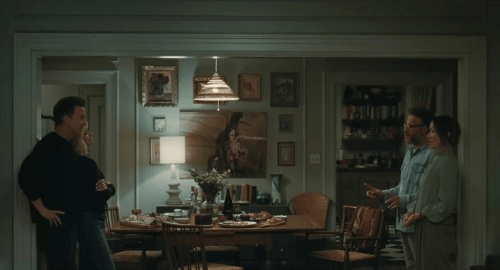
For all intents and purposes, director/star Olivia Wilde’s The Invite could be misconstrued for a “filmed play” (though, hopefully, without much of the errant nonsense loaded into that phrase), and indeed, it’s no surprise to learn that Will McCormack and Rashida Jones’ screenplay is an English-language remake of Cesc Gay’s 2020 film The People Upstairs, itself an adaptation of Gay’s play. The entire ensemble consists of four characters, and the action exclusively takes place in the apartment shared by two of them. The central scenario requires a whole lot of talking and more talking and even more talking, through either overlapping conversation or lengthy monologues.
The difference here is in the complex dynamism of Wilde’s staging and execution of the simple and very funny idea at the core of the drama (and, therefore, the comedy), which we’ll address in a moment. The setting may be an apartment, but the director and cinematographer Adam Newport-Berra somehow make what must be a pretty reasonably sized flat into both a lived-in space and a shockingly nuanced labyrinth in which to weave in and out of the pleasantries that bring these two couples together. The central scenario may be an extended joke, but the actors find some sincerity beneath the raunch and even, with a final scene of new understanding, some truth.
To be clear, the movie is mostly about the lengthy build-up to, discussion about and, for a few minutes at least, payoff to a pretty good joke, which is that Joe (Seth Rogen) and Angela (Wilde), the central couple, really need to spice up their sex life. The other couple here, Hawk (Edward Norton) and Pína (Penélope Cruz), have found a way to do that, but before anybody throws anybody else into the deep end of the proverbial pool, some talking needs to happen. Before even that, though, Joe and Angela need to talk about the process of mentally preparing for the visit.
There are certainly a couple different screenwriters and maybe a few playwrights to whom Wilde, McCormack and Jones could dedicate this effort (beyond its original progenitor, of course), because from the moment Joe arrives back at their apartment, the talk never stops. We learn that he was once a musician in a band, with a minor hit almost two decades old, and that her dreams as an artist died around the time his own segued into a dull teaching career at a small conservatory. This whole apartment, by the way, belonged to his parents and was willed to him, and given their financial status, Angela admits they’re privileged to own it: They’d never have been able to afford it on their own.
These performances announce themselves as something special right from the get-go, as Rogen introduces us with the actor’s usual “Rogenisms” (surely we can christen them with their own name by now, right?), builds upon them in every bewildered and bemused observation he makes as the story goes deeper, and then strips everything away until the very core of this man is visible to us, fragile and human. Wilde is a ball of indecisive energy, but gradually, we understand that to be something of a defense mechanism against her own building boredom within the four walls of the home they share (alongside an unseen daughter, away tonight at a sleepover). Together, the actors prove, as they have elsewhere as well, that they are incredibly generous screen partners, always in sync and in step about how to play off each other.
That extends, too, to Norton and Cruz, whose Hawk and Pína are, especially by comparison but also in general, far more enigmatic at first. Hawk is a retired firefighter (never “fireman,” he clarifies) who met Pína as her patient—though, as we might immediately imagine, this was not simply a connection made in an emergency room. Pína is a psychotherapist, which comes in handy as insecurities are revealed within all participating parties in this eventual arrangement, and it is she who has transformed Hawk’s life into the open and accepting and exploratory one that it currently is.
It might be obvious by now what sort of arrangement these four people come to as the central narrative of a fairly simple set-up, and so it is important to stop saying too much before some of the film’s biggest and funniest surprises are revealed. The centerpiece sequence might be a conversation in which the naughtiest taboos are discussed, often in graphic detail by cut quite effectively by Joe’s flabbergasted proclamations, before a sort of verbal contract can be made among these four. The jokes fly at a truly incredible pace—almost quicker, even, than the rapid-fire editing (by Yorgos Mavropsaridis and Ant Boys) is even able to make sense of the tone.
The gambit is delivered with such precision, though, that its eventual turn toward sincerity—with a series of confessionals that give each actor a dramatic monologue to accompany all the screwball silliness—is a little jarring. Wilde is efficient at the management of the film’s tone, except, perhaps, in these scenes, which arrive so late one can’t help but feel, at least a tiny bit, like the movie at large is slightly unequipped to deal with them. That’s dispelled a bit, of course, by the performances, such as a monologue by Norton’s Hawk that reveals the pain behind the silly name.
Cruz, meanwhile, somehow manages to be utterly revelatory in this, an exquisitely written and performed role the great actress could probably perform in her sleep—if not, of course, for the fact that she’s one of the best working today. Pína is the secret weapon of The Invite, if only because she undergirds this intellectually stimulating, uniquely funny exercise in talk therapy by allowing the film to provide its own psychoanalysis of itself.
Rating: *** (out of ****)

 Joel on Film
Leave a comment