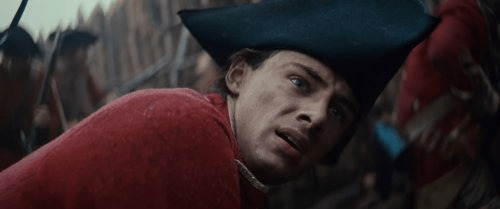
Young Washington almost tricks us into finding it more absorbing than it actually is. In its performances and with its intelligent portrait of the eventual First President of the United States, the movie is surprisingly worthwhile as a screen biography. Still, there is a nagging feeling that the screenplay (written by Diederik Hoogstraten, Tom Provost and director Jon Erwin) is simply going through the familiar motions and tied to the typical structure of such screen biographies.
There is some undeniable value to the kind of story being told here, of course, which finds a young George Washington, long before the days when he would help to forge a new government in the wake of a national independence, still vying for a position as officer in service to the British king. By virtue of his later position in life, this slice of his history is often untapped, which is especially true of the onscreen portrayals of the Founding Father. Here, he has no father or, really, any father figure in his life, on account of disease and a rumored family curse that all Washington men die suddenly.
We know this man won’t, at least, die too suddenly, because the story here takes place a couple decades before the signing of a declaration and a couple more from his greatest exhibition of leadership. For the filmmakers, the appeal of a story like this lay in seeing a younger, fitter and—most importantly—more naïve version of Washington, struggling with ideas of legacy and loyalty, but doing so in a way that almost feels foreign in the context of what he will ultimately become. For their part, Erwin and star William Franklyn-Miller, who is definitely tall enough to play this role, almost get at something interesting about this man.
The limitations of the movie around George, though, are quickly identified, because Erwin seems a little too interested in rushing through the points of George’s story. He even opens with a brief flash-forward to a key battle in the major conflict being dramatized here, before starting the story properly in George’s childhood (when he is played by Will Joseph) and at a moment of particularly overwhelming despair. Having just buried his father, George for the first time meets his half-brother Lawrence (John Foss), who agrees to raise him alongside mother Mary (Mary-Louise Parker), though the two adults have wildly different methods of child rearing.
Dazzled by the stories of British soldiers, he does indeed wish to join their ranks from an early age, but the status of his birth, his education and his land ownership (specifically, the lack thereof in all cases) eliminate the possibility of doing so by any usual means. We get a sense of the future politician by the way he sneaks into a swanky and exclusive party, by way of a very funny gag involving the slaves’ living quarters (no, really), in order to meet the Fairfaxes, a family of renown and the closest thing to royalty in the so-called New World. The son, William (Joel David Smallbone), is an arrogant cad who seeks the hand of the pretty and opinionated Sally (Mia Rodgers), but the father (played by Kelsey Grammer) is impressed by George’s tenacity.
The plan is for George to take advantage of his recent surveyor’s license to chart the apparently uncharted land surrounding the Ohio River—which, of course, is not uncharted at all but populated by Native Americans and claimed through violence by the French. Neither option sits well with British or white American forces, and so George is tasked with delivering messages, occasionally alongside threats or promises of their own violence. The natives are essentially indifferent, but the French are fatally offended and vow open warfare in response.
This, of course, means a certain number of competently staged battle sequences are to be expected, but it also means that the story becomes an exercise in repetition as the heated negotiations take place. George is sent by Gov. Dinwiddie (Ben Kingsley) to make his case to the opposing forces, who keep turning offers down and sending him back with letters of increased annoyance, and he keeps trying to prove himself to those in power, eventually falling in with Gen. Braddock (Andy Serkis). Battles are lost on account of the very different styles of warfare, until that key battle is won—depending, of course, upon whose side one takes in the conflict.
Because there’s something vital missing here, things like perspective and context are simply too broad for us to get much from this dramatic approach, which ultimately takes on the qualities of a fairly simplistic and superficial account of untapped history. Young Washington expects us to take for granted the “victory” of this battle, and while that may be patriotic in the grander sense of the history of this nation, it’s slightly questionable as an approach to drama or biography.
Rating: **½ (out of ****)
(Author’s Note: Much has been made of the film’s use of generative A.I. imagery. That’s certainly not a direction in which Hollywood or any other film market needs to go, but by this critic’s eye, it’s essentially used to embellish a handful of backgrounds and for a few offhand shots of battle preparation. There are undoubtedly worse examples out there of this tool being used, and so the distraction is fairly minor.)


Leave a comment