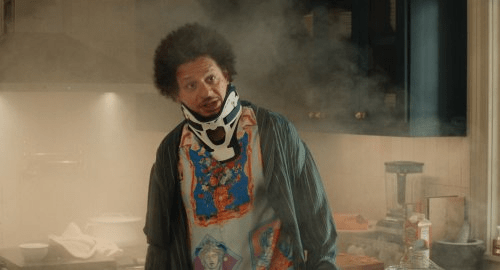
Matt Spicer’s Little Brother is so close to being a successful example of a type of very silly comedy, about a very dumb scenario, that it’s unfortunate when the screenplay (written by Jarrad Paul and Andrew Mogel but, if the outtakes over the end credits are any indication, also heavily improvised by the actors) must inevitably turn sincere in its intentions. To the credit of these actors, even when it does flirt with sincerity, the whole scenario is so dumb, so generally misguided and so over-the-top that the fact that it doesn’t quite earn the shift isn’t really something to be criticized. On the contrary, it inspires a slight breath of fresh air, even if the breath is caught in one’s throat.
After all, the sincerity still arrives, attached to the potential of the central relationship, which isn’t quite as familiar as the title suggests. Indeed, to look at the poster of a movie with this title is to realize that John Cena and Eric André can’t be related in any traditional sense. Perhaps one of these characters was adopted into the family of the other, we theorize, but no, that’s not it, either.
In this case, André’s Marcus Pinchel is “little brother” to Cena’s Rudd Landy by way of a charity organization that pits well-off kids with less-fortunate ones, to which the latter volunteered his time during high school and was paired with the former. They spent a few nice weeks together, developing a trust and the kind of bond that only this kind of pairing can develop in that timeframe, and then, they went their separate ways, as all school-aged friends typically do over the course of secondary schooling. A couple decades later, Rudd is a nationally renowned real estate agent about to land a big role on a reality television series, while we find Marcus in the middle of planning his escape from a psychiatric institution.
By virtue of how broad André’s performance is here, the movie instantly dispels the slightly awkward implications of the split between these characters in their health and wellbeing, because Marcus, beyond being potentially troubled in the mental-health department, is actually a well-meaning guy who has had the worst luck imaginable. His luck gets even worse almost immediately upon escaping the facility, because he’s run over by a garbage truck just a few hundred yards into his route. Brought to the hospital, the authorities contact Rudd, who has no idea what he’s about to face, on account of thinking the hospital was calling about his own, even more successful older brother Josh (Christopher Meloni).
Thus begins the movie’s ratatat structure of constantly trying to make the audience laugh, due to the various misunderstandings and slapstick antics that get Rudd and Marcus into a bunch of goofy, sitcom trouble. The centerpiece might be Marcus’ unintentional interruption of Rudd’s one chance to prove himself to the show’s producers (who are brutally honest and played by Ego Nwodim and Caleb Hearon), when he’s locked in Rudd’s car and really needs to use the facilities. His last-measure solution is obvious, but because André is a very funny actor, it’s somehow quite funny to see him attempt to aim the stream out the slightly cracked window.
It’s even funnier that the entire episode ends with Rudd’s car thoroughly totaled, missing a door and featuring a number of gashes from a passing vehicle, and that’s because Spicer basically knows that he’s made a goofy comedy here, filled with scenarios not quite as elaborate but occasionally just as funny as that one. The actors are game, and that extends to Michelle Monaghan as Rudd’s wife Deirdre, who gracefully accepts even the worst qualities shown by Marcus on account of her own goodness, and Sherry Cola as Rudd’s assistant Mia, who is already aware of Marcus for reasons tied to a big twist and a carnal attraction. Then, Spicer sort of upends any of the good will the movie might have upon the need to find something to resolve about this utterly goofy affair.
It’s not enough for the filmmaker or the screenwriters that we get two actors with opposite energy, like Cena and André, to riff with each other for about 100 minutes. Sometimes, the sincere angle works, like a single sequence in which Marcus opens up to Deirdre, but other times, it’s a little forced. It has to do with that big twist and Mia’s involvement in the story, in which a literal bunch of emails come into the picture and cast a new light upon these two main characters.
Marcus is revealed to be a softer presence than the previous 80 or so minutes suggested, but the truth has an unfortunate quality of reflecting poorly upon Rudd in the process. A movie as slight and silly as Little Brother has been until that point cannot sustain even a minor upheaval in its constitution like that one, and the result is a pretty funny comedy melded unevenly onto a pretty syrupy message movie.
Rating: **½ (out of ****)

 Joel on Film
Leave a comment