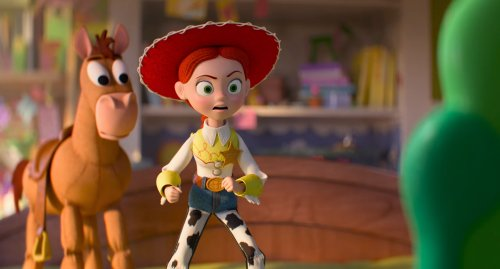
It’s now a little easier for the toys of the Toy Story universe to move amongst their human owners in Toy Story 5. That’s solidified for us in one amusing sequence where Jessie the Yodeling Cowgirl (voice of Joan Cusack), Woody the Cowboy (voice of Tom Hanks), space ranger Buzz Lightyear (voice of Tim Allen) and a whole host of others—some of them unexpected, but we’ll get to them later—hurry down a suburban street to fulfill a mission of great importance. They go through the motions of keeping a low profile, of course, but really don’t need to do so: People aren’t really paying attention to what goes on around them anymore.
That’s what rests at the heart of this fourth and sort of unexpected sequel to the trailblazing 1995 film (which is still a masterpiece, by the way). Toys of the plastic or semi-stuffed variety are a token of the past, and technology, with its bright screens and various applications, is the way of the future. In co-writer/director Andrew Stanton’s film, it arrives in the form of a tablet, on which are a host of simple strategy games and a social messaging system to keep up with friends.
The series technically ended two movies ago, when the human boy who once owned these toys went off to college and left them in the care of a girl named Bonnie (now voiced by Scarlett Spears), who is actually the protagonist of this story (from a screenplay by Stanton and co-director Kenna Harris). She still plays with toys in the physical sense, as her parents have not made the shift toward tech, but other kids are starting to notice and, in the way only kids can do, make fun of her for it. A purchase is made, and into Bonnie’s life drops a LilyPad (voice of Greta Lee), which proceeds to draw her attention away from, well, everything and everyone else.
This, of course, presents an existential threat to Jessie and Buzz and the rest of the gang (most of whom are relegated to sitting in a box in the garage for a surprising amount of time), who begin to devise schemes to steal Bonnie’s attention back from Lily. For Jessie, it’s just a reminder of a past she’d rather forget, but Stanton and Harris, apparently wanting to peel open old wounds for those of a certain generation who still tear up at hearing the notes of a certain song, force her to confront it almost directly. For Bonnie, though, the stakes are far, far more important, and it’s refreshing to see a movie in this franchise center its human character this much.
The girl comes to realize how lonely and alone she often is, and longing for some sort of human connection, she disappears into that tablet, where so-called friends are waiting on the other side of a keypad. It’s startling to see how much growth, through an equally startling amount of social disruption, this girl goes through, which must mean that she’s better written and simply a more developed character than the previous owner was over the course of his three movies of screen time. Through the expressive voice work of Spears and the efforts of the screenwriters, Bonnie takes on a life of her own and a story that’s entirely her own, even outside the context of her ownership of these toys.
Through the efforts of Jessie and a trio of new playthings—potty-trainer Smarty Pants (voice of Conan O’Brien), digital map hippo Atlas (voice of Craig Robinson), and lo-fi camera Snappy (voice of Shelby Rebara)—who lay forgotten in a drawer, Jessie does find a way for Bonnie to enjoy the best of two worlds of playtime. Without giving away too much, the yodeling cowgirl also receives a bit of closure about her own past. Lily learns something, too, and the combined effort of all these stories results in an emotional maturity that surprises for a series that has now reached its third decade of existing and entertaining.
There are a few distractions that work against its potential as one of the best movies from Pixar (which at least two, if not three, of the other films in the franchise certainly qualify to be), such as how it finds an excuse to bring Woody, who had gone on to a new life of helping toys in distress, back into the fold. There is also a distracting subplot involving a positive avalanche of Buzz Lightyears that feels entirely extraneous—or, better yet, as if some executive decided to stuff the latest idea for an animated short into the main narrative, tonal consistency be damned. These are small quibbles in the face of what the film does accomplish, though, which is to justify its existence when no such justification was immediately visible.
Whether this movie is actually the real, bona fide ending for this franchise is sort of a waiting game at this point, since we all thought that the third film had provided that finality. Toy Story 5, as with its immediate predecessor, does not quite stand beside the films of that initial trilogy cycle of following one boy and his box of toys through their natural end, but it almost doesn’t matter when this series still manages to provide a lot of laughs, a helping of heart and some worthy messages that go a little deeper than expected—if only because this has always been a series in which the technology of the future sent us a whisper about our past.
Rating: ***½ (out of ****)


Leave a Reply