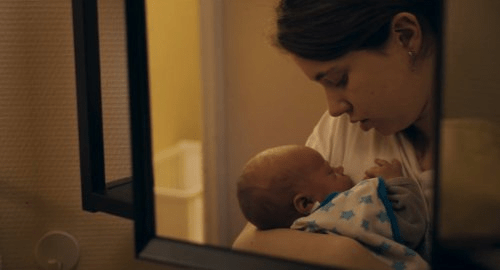
No one, of course, could possibly understand the struggle of motherhood except those who have gone through it, but with their subtly interlocking stories of five mothers—all in their late teens, all residents of a maternity shelter in the Belgian city of Banneux—fraternal writers/directors Jean-Pierre and Luc Dardenne illustrate the ways in which one can grasp through empathy. The brothers occasionally build character-based thrillers around some domestic issue, but here, the only tension arises out of the decisions made by the characters themselves. This is a wholly naturalistic, occasionally heart-wrenching effort as a result.
The narrative is split, more or less evenly, between the five young women who have had motherhood thrust upon them by their circumstances, with each one having experiences that test their resolve about the big-picture decisions they’ve chosen to make regarding their children and their situations. Importance is placed upon none of these stories at the expense of the others, with one notable exception, and the Dardennes ably avoid any kind of interchangeability between them, mostly because, in reality, every young woman’s experience is different, even between the lines of the ways they are the same. Three of these women, for instance, have opted to keep their child as this story begins, and two of those are a response to what happened with their own mothers.
That, though, is where the similarities end between Jessica (Babette Verbeek) and Perla (Lucie Laruelle), with the broadest difference being that the former is white and the latter is Black. The Dardennes don’t necessarily address the complexities of that driving difference, mainly because they’re focused on developing these characters as separately and distinctly complex. Jessica is struggling internally with the idea of keeping her own son, who will be born before the film ends, after her mother Morgane (India Hair) put her up for adopting upon the moment of birth.
Perla’s own mother struggled with alcoholism until the troubled end of a troubling life, and because she herself became a mother so young, Perla turned to the drink, as well. It’s an addiction that still has its hold on her in attempted sobriety, though, and now that she’s with a guy, named Robin (Gunter Duret), who keeps intimating that he wants neither his girlfriend nor her child to be in the lives of his family, the alcoholic pull is at its strongest in times of stress. Much stress will inevitably come to the edge of overwhelming for both Jessica and Perla, of course.
In addition to the absentee mother and the departed one, we have to contend with Ariane’s (Janaina Halloy Fokan) story, which might be the most obviously dramatic of these four. She has an erratic and abusive mother in Nathalie (Christelle Cornil), who desperately wants to find re-entry into her daughter’s life and to see her granddaughter grow up. Meanwhile, we never meet Julie’s (Elsa Houben) mother, but she’s a recovering drug addict who keeps finding new paths to heal herself, before making small concessions that might lead her down a darker path.
The Dardennes refuse to be judgmental about or toward any of these young women, allowing us to come to our own conclusions about them, and that turns out to be an easy task. These women are simply trying their absolute hardest to make it out of these trials and tribulations alive, if not particularly happy, and healthy, if not particularly well. Some of them have support where others don’t, such as the foil to Perla’s trouble with Robin being the unconditional shoulder on whom to lean for Julie in the form of her boyfriend Dylan (Jef Jacobs).
There’s also a foil for an actual mother for Perla in the form of her elder sister Angele (Joely Mbundu), whose patience has its limits but whose compassion does not. Jessica, meanwhile, seeks out her mother for some answers, finding only a brick wall of indifference when they meet, and Ariane has planned for her child to be placed in a foster home—though not, it should be said, through an entirely closed adoption process. A pair of social workers, played by Claire Bodson and Adrienne D’Anna, offer a sense of normalcy for these women, too, running a tight ship at the maternity house but with a warmth that only invites gratitude.
All of this is quiet and invites reflection and thoughtfulness, in the way for which the Dardennes have become known over the years, although the time spent with a fifth mother named Naima, played by Samia Hilmi, does struggle to benefit from the screen time afforded the other four (here to give the movie an example of a young mother who has weathered the storm). Still, Young Mothers is a good film, marked by an actual goodness that is disarming.
Rating: *** (out of ****)


Leave a comment