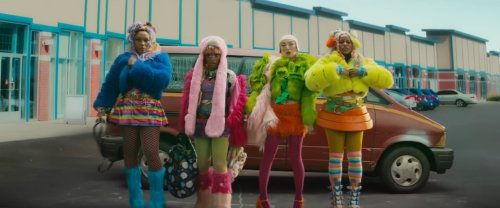
With his second film, writer/director Boots Riley proves that our initial impression was no fluke—that he’s especially interested in exploring themes of social, cultural and political revolution by way of absurdist narratives that eventually reveal themselves to fit within a particular genre context, as long as we don’t scrutinize them too closely. That might sound like a criticism, and to a certain extent, because the broadness of his satirical aims disinvites any real examination of them, it is. It’s also an observation in its own right, because I Love Boosters, as with its predecessor in Riley’s filmography, is quite, quite funny.
This is an excessive and indulgent movie, filling the frame with so much movement and color, so many ideas and concepts, that it is almost certain to overwhelm unsuspecting viewers who simply believe they’re about to watch a movie about some shoplifters on a spree. The world of Riley’s movie is, more or less, our own but tilted to such a degree that it’s nearly impossible to keep up with the doors it’s always opening. If one doubts that on the face of it, consider that the office building belonging to rich white lady is tilted 45 degrees, so that, in her own office, it’s difficult to enter or exit and also close the door.
The setting is the backdrop of a pointed satire about, obviously, capitalism, because the rich white lady in question is Christie Smith (Demi Moore), whose dull name complements her dull sense of conformity and remedial ideas around clothing style and expression. Don’t get the wrong idea, by the way: Her clothing and apparel are every conceivable color, sold in stores worldwide, but an appreciably subtle detail that is each style is monochromatic and programmed to last as a trend for only so long. At the end of that stretch, it’s no longer an acceptable style to sell.
Christie’s company is an obnoxiously powerful conglomerate, manufacturing their clothing in sweatshops in China and failing to act when, as we learn from one of the revolutionaries here, their workers fall sick due to exposure to toxic chemicals. That’s what angered Jianhu (Poppy Liu), who was a laborer in one of these sweatshops until recently, and sparked her plan for revenge, which involves a device with potentially world-changing and hilariously inscrutable powers. Its exact nature shouldn’t be revealed here, but that’s partly because it’s difficult to parse its nature in the first place.
Broadly speaking, let’s just say it can be used as both a transportation device and as a device with which to transform certain objects in a certain way. What’s most important about it is that Jianhu’s mission aligns with—and, briefly, interrupts—that of a gang of retail shoplifters, led by Corvette (Keke Palmer), whose plans involve robbing stores of their high-end apparel and selling it for a third of the sticker price. Corvette’s associates are Mariah (Taylour Paige) and Sade (Naomi Ackie), and they live in an abandoned chicken shack in the middle of San Francisco.
Much of the movie, then, is devoted their various missions, involving a good amount of reconnaissance and espionage to get in where they need to be—such as one of the stores belonging to Christie (whom Corvette admires in certain ways and despises in others), managed by the flamboyant Grayson (a hilarious Will Poulter), in which another worker, Violeta (Eiza González), is already planning some type of unionized action. Once Jianhu joins the crew, ambitions expand to include the whole of Christie’s company. Christie vows to fight back when she discovers what’s going on.
The film is an absolute explosion of grandiloquent aesthetic, from how every piece of Shirley Kurata’s costume design (not to mention hair and makeup) is as garish and effusive as the sets on which the actors have found themselves. Christopher Glass’s production and Natasha Braier’s photography suggest that both creators would rather have resigned their jobs than to let anything drab into the mix, and the score by art pop outfit Tune-Yards (aka Merrill Garbus and Nate Brenner) threatens to drown the dialogue mix on occasion. Movies are meant for the big screen, whatever recent trends might say, and this one out-movies a lot of others on those grounds.
Eventually, though, Riley’s predisposition toward those genre elements must come into play, and they aren’t only located in the literal plot device, either. Some of the swings work in an over-the-top and very amusing way, like everything to do with a group of executives and other powerful people (played by Jason Ritter, Jermaine Fowler, Kara Young and a nearly unrecognizable Don Cheadle) whose role in the finale is a gruesome surprise. Some of it really doesn’t, like a character played by Lakeith Stanfield whose sole purpose for being here is a satirical point that has nothing to do with anything else.
All of it, though, is certainly something, and if not all of its political storytelling aspirations are explored, they certainly provoke exactly the feelings—and more—Riley desires. Yes, I Love Boosters is excessive and indulgent, but it’s pointed and funny in all the ways it’s both.
Rating: *** (out of ****)


Leave a comment